
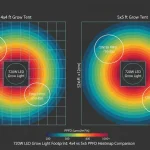
Large agriculture projects don’t “buy lights”—they buy predictable photons at scale. If you’re building or upgrading a greenhouse block, a vertical farm, or a multi-room indoor facility, the wrong LED partner shows up later as uneven PPFD, control headaches, and ROI that never pencils out. I’ve been pulled into projects where the fixtures were “efficient on paper,” but the corners of the canopy told the real story—yield variability, hot spots, and rushed re-layouts. This guide breaks down top LED grow light firms for large ag projects, what to evaluate beyond brand names, and how to choose a vendor that can deliver on design, supply, controls, and long-term service.

What “Top” Means for Large Ag LED Projects (Beyond the Logo)
In large deployments, “top” is less about marketing and more about whether the firm can engineer, deliver, and support a system across thousands of fixtures.
Key performance and execution signals I look for:
- Efficiency (PPE) and usable photons (PPF/PPFD uniformity): High PPE lowers energy cost, but uniform PPFD across the grow area prevents quality swings. Industry commentary also warns against focusing only on center PPFD readings while corners collapse.
- Driver quality + dimming/control: Commercial-grade drivers (often Mean Well or Inventronics) with 0–10V control are common in serious projects.
- Thermal management and longevity: Heat handling (heatsinks, airflow, sometimes active cooling) is what keeps output stable over time.
- Project services: Lighting plans, load calculations, zoning, mounting strategy, commissioning, and post-install tuning matter as much as the fixture.
For market context, the LED segment is now the largest revenue share in horticulture lighting (over half in 2024), driven by efficiency and spectral control needs in commercial operations, per Grand View Research’s market analysis: horticulture lighting market report.
Shortlist: Top LED Grow Light Firms for Large Ag Projects (and Where They Fit)
Below are firms frequently cited or widely deployed in commercial greenhouse, indoor, and vertical farming projects—plus what they’re typically chosen for.
1. Signify (Philips GreenPower / Fluence)
For large greenhouse networks and enterprise indoor builds, Signify’s ecosystem is often treated as a benchmark. Philips horticulture solutions are widely installed across greenhouse facilities globally, with market analyses reporting meaningful share and broad deployment. If your project needs established global support, proven “light recipes,” and integration-friendly controls, this is a common starting point. See industry market coverage listing Philips among leading horticultural LED companies: Business Research Insights market overview.
2. Gavita (Hawthorne / ScottsMiracle-Gro)
Gavita is repeatedly referenced for projects ranging from single rooms to very large greenhouse and indoor footprints. Their strength is familiarity in the commercial grower channel and a robust ecosystem of fixtures and accessories. MarketsandMarkets notes Gavita’s presence in large projects and broad distribution: Gavita company mention.
3. ams OSRAM (components and horticulture solutions)
OSRAM is a major player both as a component supplier (LEDs) and as an enabling technology layer for many OEM fixtures. For large projects, OSRAM’s relevance shows up when you’re specifying diode performance, bins, and long-term supply continuity. Business Research Insights lists Osram among top horticultural LED lighting companies and reports notable installation share: horticultural LED lighting companies.
4. Heliospectra
Often considered where research-backed spectral strategies and controllability matter. If you’re operating multiple cultivars, running trials, or dialing recipes to hit quality targets, companies in this category tend to emphasize controllable spectra and data-led cultivation.
5. Valoya
Valoya is commonly associated with plant-science-driven spectrum development and applications where crop-specific spectral tuning is a priority (propagation, specialty crops, R&D-heavy facilities).
6. HLG (Horticulture Lighting Group)
HLG is frequently highlighted in commercial LED retail and specification lists, with fixtures positioned for high intensity and strong efficacy. For example, Hydrobuilder showcases commercial-grade models and publishes performance specs such as wattage, efficacy, and PPF outputs: commercial grow lights overview.
7. Fohse / Photontek / ThinkGrow (commercial-focused brands)
These brands appear often in commercial assortments and large-grow discussions, typically selected based on fixture format (bars vs. panels), intensity requirements, and control stack compatibility in indoor production.
Important: “Top LED grow light firms for large ag projects” will vary by crop, facility type, and region. A tomato greenhouse retrofit and a multi-tier leafy greens rack build have totally different constraints (beam angle, mounting height, heat, and controls).
Where ABEST (ProLEDGrowLight.com) Fits for Large Ag Projects
ABEST (ProLEDGrowLight.com) is built around what large projects usually struggle with: customization + engineering support + repeatable manufacturing. With 13+ years in LED grow light manufacturing and an ODM model, ABEST is a fit when you need:
- Full fixture customization: appearance, spectrum design, and fast plan delivery.
- Project services: light calculations, technical consultancy, and project management support.
- Broad wattage and formats (25W–2000W): Grow Light Bars, Boards, Under Canopy Lights, and Clone Lights for hydroponics, greenhouse, vertical racks, urban farms, and medicinal crops.
- Smart controls: App/WiFi controllable bars, multi-channel dimming, adjustable spectra across growth stages.
In practice, I’ve seen large operators succeed when they treat lighting as a system—toplight + under-canopy + zoning + control logic. ABEST’s ability to adapt spectrum and control systems by crop and room is exactly what makes scaling more predictable, especially when you’re standardizing across multiple bays or sites.
To align stakeholders early, it also helps to educate teams on plant-light basics and avoid common misconceptions—this internal resource is useful for that: LED Lights and Plants: Myth-Busting Indoor Growth Facts.

Comparison Table: Picking a Firm by Project Type
Use this as a practical filter when building your shortlist of top LED grow light firms for large ag projects.
| Project scenario | What matters most | Best-fit firm type (examples) | Questions to ask in procurement |
|---|---|---|---|
| High-wire greenhouse (tomato, cucumber, pepper) | High-output toplight, uniformity, corrosion resistance, hybrid LED/HPS transition plan | Enterprise greenhouse providers (e.g., Signify/Philips, Gavita) | Can you provide photometrics, layout, and energy model? What’s the warranty process for 1,000+ fixtures? |
| Vertical farming racks (leafy greens, microgreens) | Low-profile bars, wide beam, low heat near canopy, tight dimming control | Vertical-optimized bar vendors; ODM bars (e.g., ABEST), specialty vertical lines | What’s the fixture thickness and thermal behavior at 100%? What control protocol is supported (0–10V, networked)? |
| Indoor multi-room (medicinal crops) | High PPFD with strong uniformity, zoning, failover, surge protection | Commercial indoor brands + integrators (e.g., Gavita/HLG/Fohse category; ABEST ODM for standardization) | What’s corner PPFD at mounting height? Driver brand? Can you do multi-channel spectra per room? |
| Retrofit with utility rebates | DLC/region compliance, controllability, measured savings, documentation | Brands experienced with rebate paperwork + engineering partners | Who provides the rebate cut sheet, LM-79/LM-80 related documentation, and as-built drawings? |
| Multi-site standardization (repeat builds) | BOM stability, supply continuity, consistent binning, service SLAs | Manufacturers with strong production + ODM capability (e.g., ABEST) and global support brands | Can you lock the BOM and diode bins for 12–24 months? What’s lead time at 5,000 units? |
Procurement Checklist: How to Evaluate LED Grow Light Firms at Scale
When budgets hit six or seven figures, due diligence must go past brochures.
Photometrics and canopy outcomes
- Request IES files, proposed mounting heights, and PPFD maps showing average and uniformity, not just peak center values.
- Confirm the target PPFD is realistic for your crop and strategy (CO₂ enrichment, DLI goals, photoperiod).
- Ask for a plan to manage edge zones, aisles, and shadowing.
Components that predict reliability
- Driver brand and efficiency, surge protection, and dimming method (0–10V is common in commercial deployments).
- Thermal design: ask how the fixture maintains output in warm, humid environments over long hours.
Controls and commissioning
- Confirm how you’ll:
- group fixtures into zones,
- schedule recipes,
- monitor power/alerts,
- handle network outages (manual override matters).
Operations and serviceability
- What is the swap time per fixture?
- Are parts modular (drivers, boards, bars)?
- What’s the process for warranty replacements across multiple sites?

Budgeting and ROI: What to Model (So Finance Trusts the Plan)
A solid lighting ROI model for large ag should include:
- Energy (kWh) and demand charges: LEDs reduce watts, but also can reduce cooling load indoors.
- Yield and quality uplift: Not guaranteed—depends on uniformity, recipe, and how well you run the room after install.
- Maintenance delta: fewer lamp changes vs. HPS, but you must price driver/fixture failure rates and labor.
- Rebates and compliance: in some regions, controllability and documentation can materially affect rebate eligibility.
I recommend you run at least two scenarios: conservative (energy savings only) and operational (energy + measured yield/quality improvement). Some case studies from manufacturers report yield improvements under specific conditions, but you should validate in your facility with trials before betting the project on it.
Recommended Shortlist Approach (Fast and Defensible)
If you need a clean way to choose among top LED grow light firms for large ag projects, use this 3-step process:
- Segment by facility type (greenhouse toplight vs. vertical racks vs. indoor rooms).
- Select 2–3 vendors per segment (include one “enterprise” brand and one “engineering/ODM” manufacturer).
- Run a paid pilot or instrumented trial in a representative zone, measuring PPFD maps, kWh, canopy temperature, and crop KPIs.
This is where ABEST often wins: when a project needs ODM customization, fast iteration on spectrum/control, and consistent manufacturing across repeat builds—not just an off-the-shelf fixture.
Conclusion: Choose a Firm That Can Deliver Photons and Projects
At scale, the best outcomes come from firms that treat lighting as a full system—photometrics, controls, commissioning, and long-term service—not just a box of fixtures. The “top LED grow light firms for large ag projects” list usually includes global leaders like Signify (Philips/Fluence) and Gavita, plus specialists like Heliospectra and Valoya for spectral strategy, and commercial brands like HLG/Fohse/Photontek categories depending on application. If your priority is custom ODM design, spectrum tailoring, and end-to-end project support, ABEST (ProLEDGrowLight.com) is a strong fit for large builds that need speed, repeatability, and configurable control.
📌 grow smarter not harder the led grow light bar that actually works
FAQ: Top LED Grow Light Firms for Large Ag Projects
1) Which LED grow light firms are best for large greenhouse installations?
Look for firms with proven greenhouse deployments, photometrics support, and scalable controls—often including Signify (Philips), Gavita, and other established horticultural lighting suppliers.
2) What specs matter most when comparing top LED grow light firms for large ag projects?
Prioritize PPFD uniformity maps, PPE, driver brand/efficiency, control protocol (often 0–10V), thermal management, and service/warranty logistics at high fixture counts.
3) Are tunable spectrum LEDs worth it for commercial agriculture?
They can be—especially in vertical farming and multi-crop facilities—if your team will actually run recipes and track outcomes. Otherwise, a stable spectrum with excellent uniformity can outperform “tunable” systems that go unused.
4) How do I evaluate under-canopy lighting vendors for dense canopies?
Check fixture form factor, mounting method, IP rating, cleanability, and how under-canopy zones integrate with toplight scheduling and dimming.
5) How many LED vendors should I include in an RFP?
Typically 3–5 is manageable: one enterprise brand, one strong commercial brand, and one ODM manufacturer (like ABEST) if customization and standardization are important.
6) What’s the most common mistake in choosing a grow light company for big projects?
Overweighting peak PPFD or listed efficacy while ignoring corner uniformity, controls integration, commissioning, and replacement logistics.
7) Can an ODM manufacturer be a safer choice than a famous brand?
For repeat builds and crop-specific needs, yes—if the ODM partner can document performance, lock BOM consistency, and support commissioning and after-sales at scale.