
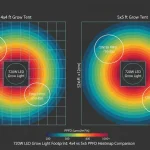
A 720W LED grow light looks simple on paper: hang it, plug it in, grow. Then your tent tells a different story—tight, dense tops in the center, airy edges, or worse, light stress because the fixture is “too close but still not wide enough.” If you’re choosing between a 4×4 vs 5×5 footprint, the real skill is mapping coverage and dialing height + dimming to match your canopy, not chasing watt numbers. This how-to walks you through a practical coverage map approach used by commercial lighting teams and manufacturers like ABEST (ProLEDGrowLight.com).

What “coverage” really means for a 720W LED grow light
Coverage is not “will it light the space.” Coverage is: Can you maintain your target PPFD across the whole canopy with acceptable uniformity. A 720W LED grow light in a bar-style layout often delivers strong center intensity; the question is how far edges and corners fall behind.
Three terms to keep straight:
- PPF (µmol/s): total photons produced by the fixture. Many 720W fixtures land roughly in the ~1800–2000 µmol/s class (example spec: 1872 µmol/s at 720W, 2.6 µmol/J) per an ION Lighting 720W listing.
- PPFD (µmol/m²/s): photons hitting a square meter each second (what your canopy “feels”).
- Uniformity: how close edge/corner PPFD is to center PPFD. Better uniformity usually means better whole-canopy yield consistency.
If you want a quick refresher on how testers report PPFD and efficiency, see this internal deep dive: Advanced LED Grow Light Review: 2026 Test Bench Results.
4×4 vs 5×5: the math that changes everything
A 4×4 is 16 ft². A 5×5 is 25 ft². That’s a 56% bigger area in 5×5, so the same 720W LED grow light must either:
- spread the same photons thinner (lower average PPFD), or
- hang higher / use optics to improve uniformity (often lowering peak intensity), or
- run CO₂ and higher total PPF (if you upgrade above 720W)
Rule of thumb for flowering: many growers aim for roughly 700–800W of high-efficacy LED to maximize a 5×5 at strong intensity levels, while ultra-high PPFD setups may require CO₂ to make sense (a point echoed in MIGRO’s 5×5 guidance). For a 4×4, 720W is typically “high power,” meaning dimming and height matter more than raw output.
Step-by-step: build a practical coverage map (even without lab gear)
You can map a 720W LED grow light in 20–30 minutes. I’ve done this in production rooms and small tents; the biggest “aha” is how much corners lag when the light is hung too low.
1) Choose your target PPFD by growth stage
Start with simple targets (adjust for cultivar and environment):
- Seedlings / clones: ~100–300 PPFD
- Vegetative: ~300–600 PPFD
- Flower: ~700–1000 PPFD (higher often benefits from CO₂, excellent HVAC, and perfect nutrition)
If you want a distance-based starting point for high-watt LEDs, Gorilla Grow Tent’s distance guidance is a helpful sanity check, but treat it as a starting point—not truth. Use measurement when possible: LED Grow Light Distance Chart.
2) Create a 9-point grid on your canopy
Mark these points with tape or string:
- Center
- Mid-edges (north/south/east/west)
- Four corners
Record PPFD (PAR meter preferred). If you don’t have a meter, you can still do a “relative map” using a reputable phone-lux method, but it’s less reliable—borrow/rent a meter if yield matters.
3) Hang at a realistic starting height, then adjust
For a 720W LED grow light, a common workable starting range is:
- Veg: 24–30″ above canopy (or dimmed lower)
- Flower: 12–18″ above canopy (then tune)
Higher hang height usually:
- improves edge/corner PPFD (better uniformity), but
- reduces peak PPFD in the center.
That tradeoff is why two growers can use the same 720W fixture and get totally different results.
4) Decide: tune for “4×4 max” or “5×5 even”
Use your map results to pick one strategy:
- 4×4 strategy: keep a slightly lower hang height and/or higher power to drive high average PPFD.
- 5×5 strategy: hang higher (often ~16–24″) to pull light out to corners, accept lower average PPFD unless CO₂ and canopy management are top tier.

How to interpret your coverage map (the uniformity shortcut)
After you log readings, calculate:
- Average PPFD across all points
- Uniformity ratio = corner PPFD ÷ center PPFD
Quick interpretation:
- 0.70–0.85: strong uniformity (excellent for even canopy yield)
- 0.55–0.70: workable, common in tents
- <0.55: corners are underlit (you’ll see larf/loose buds or uneven veg growth)
A bar-style 720W LED grow light with good spacing, reflectors, or optics typically improves uniformity versus older board-only layouts—one reason many modern 720W fixtures are marketed for 5×5 bloom.
4×4 vs 5×5 setup recipes (height + dimming that actually works)
These are practical baselines I’ve used when commissioning fixtures for growers who want repeatable results. Adjust based on cultivar response, training style, and CO₂.
Recipe A: 720W LED grow light in a 4×4 (flower-focused)
Goal: high average PPFD, dense tops, managed stress.
- Hang height: start ~14–18″
- Dimming: start 70–90% (don’t assume 100% is “best”)
- Map & tune: if center is too hot and corners lag, raise 2–4″ before increasing power
- Canopy: keep it flat (SCROG / trellis) to reduce hot spots
Signs you’re pushing too hard:
- top leaves tacoing/praying hard then bleaching
- crispy margins at the very top
- stalled growth despite strong light (often environment/nutrition mismatch)
Recipe B: 720W LED grow light in a 5×5 (uniformity-focused)
Goal: acceptable corners without sacrificing the whole run to underlit edges.
- Hang height: start ~18–24″
- Dimming: start 90–100% only if temps/VPD are stable
- Map & tune: prioritize corners—if corners are low, raise height first
- Optional: use reflective walls, keep drivers external if possible, and avoid huge gaps at tent sides
In MIGRO’s tests and commentary, many 5×5 fixtures show improved edge performance at higher hangs (often around 12–18″ depending on model). Treat those heights as model-specific, but the principle holds.
A quick comparison table: 4×4 vs 5×5 with a 720W LED grow light
| Factor | 4×4 with 720W LED grow light | 5×5 with 720W LED grow light |
|---|---|---|
| Area | 16 ft² | 25 ft² |
| Typical outcome | Very high intensity possible; must manage stress | More even canopy challenge; corners are the limiting factor |
| Best tuning knob | Dimming + height to avoid center hot spots | Height + layout/optics to improve uniformity |
| Common risk | Light burn/bleaching at the top | Underlit corners, airy buds/slow veg on edges |
| When it shines | Maxing yield in a compact tent | Solid bloom coverage if fixture is designed for 5×5 uniformity |
| When to upgrade | If you want extreme PPFD + CO₂ or multi-tier | If you need >900–1100 PPFD average without CO₂ tradeoffs |
Is 720W LED better than HPS (and what that means for coverage)
In real grows, a 720W LED grow light can match or exceed the usable canopy light of a 1000W HPS, often with:
- lower power draw for similar PPF
- less radiant heat at the canopy (different HVAC needs)
- better control (dimming, multi-channel spectrum on advanced models)
That doesn’t mean “no heat” or “always better.” LEDs still dump heat into the room (they’re efficient, not magic). But coverage-wise, modern 720W bar fixtures are engineered for uniform PPFD, something many HPS reflectors struggle with unless you run multiple fixtures and manage overlap.
For a broader comparison, you can reference: Indoor LED Grow Light vs HPS: Which Wins Indoors?.
Spectrum notes (simple, useful, and not marketing fluff)
People ask “what two colors encourage flowering?” The short version: red and blue are key drivers, but modern “full spectrum” fixtures add broad white (and sometimes deep red/far-red) to support balanced growth and penetration.
From a manufacturer perspective (ABEST’s ODM work often centers here), spectrum tuning matters most when:
- you’re dialing morphology (stretch control in veg)
- you’re targeting crop-specific responses (leafy greens vs fruiting crops)
- you’re integrating controls (multi-channel dimming, schedules)
If you want the deeper science without jargon overload, see: LED Grow Light Spectrum Explained: Red vs Blue vs Full Spect.
Troubleshooting: why your “coverage” looks wrong
Most coverage problems are setup problems. Here’s the fastest fix list.
If the center is great but edges are weak
- Raise the fixture 2–6″ and re-map
- Improve wall reflectivity / reduce light leaks
- Ensure bars are oriented correctly (some fixtures have best spread in a specific direction)
If plants show light stress even at the edges
- Dim down 10–20% and keep height constant for 48 hours
- Check leaf temp and VPD; “too much light” is often “too much light for the current environment”
- Confirm your PPFD meter is not misreading (wrong mode or bad calibration)
If a 5×5 feels disappointing on 720W
- Accept that 5×5 is 56% more area than 4×4
- Aim for better uniformity rather than chasing center peak
- Consider CO₂ only if your HVAC, irrigation, and nutrition are already consistent
How To Determine LED Grow Light Distance With Dimmer!
Notes from the field (experience that saves time)
When I first mapped a 720W class bar fixture in a 5×5, I assumed “lower is stronger.” The center number was impressive—and the corners were not. The winning move was raising the light and slightly increasing power to keep the average up, which improved corner density and made harvest much more consistent. That one change also made trimming faster because the “edge larf” problem dropped.
Conclusion: pick the footprint first, then make the 720W LED grow light behave
A 720W LED grow light can be a monster in a 4×4 and a capable workhorse in a 5×5—if you map PPFD and tune height/dimming for uniformity. In 4×4, your job is usually preventing excess intensity; in 5×5, your job is usually rescuing corners. Once you treat “coverage” as a measured map instead of a spec-sheet claim, your results become predictable.
If you want help choosing a bar layout, spectrum, or control approach for your crop and room, ABEST (ProLEDGrowLight.com) builds ODM solutions and can provide light calculations and project support. Share your tent size, ceiling height, and target crop in the comments and I’ll suggest a starting height + dimming plan you can test.
📌 grow smarter not harder the led grow light bar that actually works
FAQ: 720W LED grow light coverage and setup
1) Is 720W LED better than 1000W HPS?
Often yes for efficiency and control: many 720W LEDs can deliver similar usable canopy light to 1000W HPS with less power and less radiant heat at the canopy, depending on fixture efficacy and layout.
2) Can a 720W LED grow light flower a 5×5?
Yes, especially with a bar fixture designed for 5×5 uniformity. Expect lower average PPFD than the same light in a 4×4, and prioritize corner readings when you map.
3) Is 700–720 watts enough for my grow tent size?
Typically strong for 4×4 flower and workable for 5×5 flower. Your real limiter is uniformity and your target PPFD, not watts alone.
4) How high should I hang a 720W LED grow light?
Common starting points: ~24–30″ for veg and ~12–24″ for flower, then adjust based on PPFD mapping and plant response. Higher improves uniformity; lower increases center intensity.
5) Can you have too much LED light in a grow tent?
Yes. Too much PPFD (or too much PPFD for your environment) can cause bleaching, leaf burn, or stalled growth. Dimming and raising the fixture are the fastest corrections.
6) What colors of light help flowering most?
Red and blue are the key photosynthetic drivers, but full-spectrum white plus deep red is common in modern fixtures for balanced growth and canopy penetration.
7) What’s the simplest way to check coverage without guessing?
Make a 9-point grid at canopy height and measure PPFD (center, edges, corners). Tune height first for uniformity, then dimming for your target average PPFD.
Authoritative references used: MIGRO: best value grow lights for 5×5 (720W class discussion), Gorilla Grow Tent LED distance chart, ION Lighting 720W spec example
