
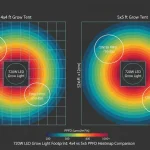
A spectra LED grow light can be a plant’s best friend—or its worst enemy—depending on how high you hang it. I’ve watched perfect seedlings turn leggy in a week from a light that was too far, and I’ve also seen healthy leaves bleach overnight from a fixture that was too close at full power. The good news: you don’t need guesswork. With a simple hanging-height chart, a PPFD target, and a few visual cues, you can dial in your spectra LED grow light fast and keep it dialed in as the canopy changes.

Why hanging height matters (more than “full spectrum” marketing)
Hanging height controls intensity at the canopy and uniformity across the grow area. Light closer to the plants boosts PPFD in the center but can create hot spots and edge drop-off; higher mounting usually improves uniformity but lowers peak PPFD. This is why many manufacturers and independent testers often land in a practical middle band—roughly 12–18 inches (30–45 cm) for many modern LED fixtures in flower—then adjust with dimming and plant feedback.
Key concepts to keep straight:
- PPFD (µmol/m²/s): the “speed” of photons hitting your canopy.
- DLI (mol/m²/day): the “total daily dose” (PPFD × hours).
- Uniformity: how even the PPFD is from center to edges (crucial for consistent growth).
Authoritative guidance commonly used in the industry pegs target PPFD bands by stage at about 100–300 (seedlings), 400–600 (veg), and 800–1,000 (flower). See Mars Hydro’s explanation of stage-based PPFD targeting and why it’s the first step in setting hanging height: recommended PPFD ranges by growth stage.
Best hanging height chart for a spectra LED grow light (quick start)
If you don’t have a PPFD meter yet, start with a conservative height and “walk it down” over 3–7 days while watching leaves. This chart assumes a typical modern full-spectrum LED board/bar in the 100W–600W class with dimming (common in tents, racks, and small rooms).
Hanging height by growth stage (distance to canopy)
| Growth stage | PPFD target (µmol/m²/s) | Starting height (in) | Starting height (cm) | Typical dimmer range* | What you’re optimizing |
|---|---|---|---|---|---|
| Seedling / clones | 100–300 | 24–36 | 60–90 | 20–40% | Gentle intensity, avoid stress |
| Vegetative | 400–600 | 18–24 | 45–60 | 40–70% | Compact growth, steady node spacing |
| Flower / fruiting | 800–1,000 | 12–18 | 30–45 | 70–100% | Yield and canopy penetration |
*Dimmer ranges are practical starting points. Your actual spectra LED grow light efficiency, lensing, and bar/board geometry can shift these.
This general distance guidance aligns with widely published “rule-of-thumb” ranges (e.g., 24–36″ seedlings, 18–24″ veg, 12–18″ flower) while emphasizing that PPFD beats inches for accuracy. For a simple overview of those stage distances, see: LED grow light distance chart.
Use the “uniformity vs intensity” rule to fine-tune height
Here’s the trade-off I see most often in real grows: growers chase maximum center PPFD and accidentally punish the top leaves while the corners underperform. Independent testing notes that raising the fixture can improve edge PAR and uniformity (at the cost of peak intensity), which is often a better yield strategy for flat canopies.
Practical tuning steps:
- Set a safe baseline (use the table above).
- Aim for even coverage first
- If corners look weaker, raise the light 2–4″ (5–10 cm) and compensate with dimming if needed.
- Then increase dose (DLI)
- Extend hours or raise intensity gradually, not both at once.
- Never jump more than ~10–15% intensity per day
- Plants need a short “hardening” period when moving from veg to bloom intensity.
If you want a PPFD-first setup approach (especially helpful for high-efficiency diodes), this walkthrough is a strong companion: Samsung LED Grow Light Setup Tutorial: Max PPFD Fast.

“Spectra” explained: what spectrum an LED grow light actually uses
When people say spectra LED grow light, they’re usually talking about a “full spectrum” blend that covers the core PAR range (400–700nm) and often adds deep red (660nm) and sometimes far-red (730nm), plus small amounts of UVA depending on design. The goal is not to copy sunlight perfectly—it’s to deliver the wavelengths plants use efficiently while controlling stretch, leaf morphology, and flowering response.
A practical way to think about spectrum by stage:
- Seedling/veg: slightly more blue influence can support tighter internodes and leaf development.
- Flower/fruit: more red/deep red supports photosynthetic efficiency and flowering productivity.
- Far-red: can influence shade-avoidance and flowering signals; great when applied intentionally, risky if overdone at close distance.
Do full spectrum grow lights work? Yes—because balanced spectra support photosynthesis across many crops and stages, assuming you also deliver the right PPFD + photoperiod.
The ABEST approach: height + dimming + crop-specific spectrum (why it’s not one-size-fits-all)
ABEST (ProLEDGrowLight.com) builds LED solutions from 25W to 2000W, so the “best height” depends heavily on fixture format and application. In my experience working with bars, boards, and under-canopy systems, the biggest wins come from combining:
- Fixture geometry: bars generally spread photons more evenly than dense point-source designs.
- Multi-channel dimming: lets you keep height for uniformity while tuning intensity.
- Spectrum tailoring: adjusting channels by crop and stage reduces wasted energy and stress.
This is exactly where ABEST’s ODM capability matters in real projects: appearance + spectrum customization, rapid plan delivery, and project services like light calculations and control adaptations for specific crops (hydroponics, vertical farming, greenhouse, medicinal crops, and home grows).
For growers deciding between fixture styles in stacked or rack environments, this deeper breakdown is useful: Vertical LED Grow Light Deep Dive: Coverage, Heat, ROI.
How to measure your spectra LED grow light height correctly (and avoid common mistakes)
Most “distance” problems come from measuring to the wrong spot or ignoring canopy changes.
Measure like this:
- Measure from the LED emitting plane (bottom of the fixture) to the highest point of the canopy.
- Re-check after training, pruning, or rapid stretch (especially week 1–3 of flower).
- If you can, confirm with a meter: PAR/PPFD meter > lux meter for accuracy. Lux can still be a rough proxy, but it’s not crop-agnostic.
Common symptoms and the fix:
- Light too close / too intense
- Signs: leaf tacoing, bleaching, crispy serrations, stalled tops
- Fix: raise 2–6″ (5–15 cm) or dim 10–20%, then reassess in 24–48 hours
- Light too far / too weak
- Signs: stretching, thin stems, slow growth, big internode gaps
- Fix: lower 2–4″ (5–10 cm) or increase intensity gradually
For manufacturer guidance and real model examples of hanging heights across common grow areas, this compiled testing resource is helpful: how high to hang your grow light for maximum yields.
How To Determine LED Grow Light Distance With Dimmer!
Quick recommendations by fixture power (sanity check)
If all you know is wattage, use this as a sanity check—then confirm with PPFD maps or a meter:
- 100–200W (small tents, seedlings, herbs): 18–30″ depending on optics and dimming
- 250–400W (2×4 / 3×3 class): 12–24″ typical working range
- 500–800W (4×4+ or high-intensity rooms): 18–36″ often needed for uniformity and comfort
Remember: “watts” isn’t the whole story—efficacy (µmol/J), diode layout, and driver current can make two “same watt” lights behave very differently.
Example: dialing in a spectra LED grow light in 7 days (simple, repeatable)
This is the exact pattern I use when I don’t fully trust the starting settings:
- Day 1: Hang at veg height (18–24″) and dim to ~40–50%.
- Day 2–3: If leaves look flat and happy, increase intensity ~10%.
- Day 4: Check for edge weakness; if corners lag, raise light 2–3″ and add ~5–10% intensity.
- Day 5–7: Lock in the setting that gives:
- healthy leaf posture
- compact spacing (in veg)
- no bleaching on tops (in flower)
Once you hit flower stretch, re-check daily—height that was perfect in week 1 can be too close in week 3.
Conclusion: the “best height” is the one your plants can use
A spectra LED grow light delivers results when height, intensity, and spectrum work together—not when you chase a single distance number. Start with the hanging height chart, prioritize uniformity, and use PPFD targets to guide changes. If you’re building anything beyond a single tent—racks, vertical farming, greenhouse lanes—lean on proper light calculations and a controllable fixture strategy so you can stay consistent across seasons and cultivars.
📌 grow smarter not harder the led grow light bar that actually works
FAQ: Spectra LED Grow Light Hanging Height & Spectrum
1) Do full spectrum grow lights actually work?
Yes. Full-spectrum LEDs can support photosynthesis across stages when you deliver the right PPFD and photoperiod. Results depend more on dose (PPFD/DLI) and coverage uniformity than on “full spectrum” labeling alone.
2) How high should I hang a spectra LED grow light for seedlings?
Start around 24–36 inches (60–90 cm) or dim down to hit 100–300 µmol/m²/s at canopy level. If seedlings stretch, increase intensity slowly or lower the fixture a few inches.
3) What is the best light schedule for vegetative growth?
A common indoor schedule is 18 hours on / 6 hours off. Pair that with a veg PPFD target around 400–600 µmol/m²/s and adjust height/dimming to match.
4) Can too much LED light hurt plants?
Yes. Excess intensity can cause bleaching, tacoing, or leaf burn. Raise the light or dim it, then reassess in 24–48 hours.
5) What spectrum are LED grow lights?
Most grow LEDs blend wavelengths across 400–700nm (PAR) with additions like deep red (660nm) and sometimes far-red (730nm). Some designs include UVA in controlled amounts for crop-quality goals.
6) Do grow lights run up your electric bill?
They can, but cost depends on wattage, photoperiod, and utility rate. High-efficacy LEDs and smart dimming help control operating cost while keeping target PPFD.
7) Can grow lights help with seasonal depression?
Grow lights for plants are not the same as medical-grade light therapy lamps. If your goal is mood support, look for products specifically designed and certified for light therapy and talk with a clinician if you have concerns.