
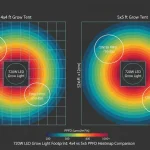
A Samsung LED grow light can feel like a sports car the first day you install it: lots of potential, but you won’t get “max PPFD fast” if your height, dimming, and map are off. I’ve helped growers (and set up my own test racks) where the fixture was “powerful,” yet plants still stretched—because the center PPFD was high while the edges were starving. The goal of this tutorial is simple: hit your target PPFD uniformly and convert it into the right DLI for your crop.

Why “Samsung LED grow light” usually means LM301-series + good optics/layout
When people say Samsung LED grow light, they often mean fixtures built with Samsung horticulture diodes like LM301H/LM301 variants paired with reds (commonly 660 nm) and sometimes far-red (730 nm). The practical win is high photon efficacy, so you get more usable photons per watt when the fixture is driven and cooled correctly. Samsung also publishes horticulture component data and spectrum research that supports full-spectrum strategies for leafy greens and controlled environments (see Samsung’s horticulture resources like the LM301H page and their horticulture lighting applications).
For setup, though, chip brand is only half the story. Mounting height, dimming, and canopy coverage decide whether you get fast growth or light stress.
Tools you need (and what to do if you don’t have them)
To maximize PPFD quickly, you need measurements—not guesses.
Best-case tools
- PAR/PPFD meter (ideal) to read μmol/m²/s at canopy level
- Tape measure (height consistency matters)
- Adjustable hangers + stable mounting
- Timer (or controller) for photoperiod consistency
No PAR meter? Use a “good-enough” workflow
- Use the manufacturer’s PPFD map as your starting point.
- Validate with plant response: praying leaves good; taco/canoe, bleaching, or stalled tops = too intense.
- Upgrade later: the first time I bought a PAR meter, it paid for itself by stopping me from over-lighting a 4×4 and chasing nutrient “problems” that were actually light stress.
If you’re new to these metrics, the internal guide on PAR & PPFD breaks down the terms in plain language.
Step 1: Set a PPFD target (then translate it to DLI)
PPFD is the light intensity at a moment. DLI is the total photons per day—often what your crop really “feels.” Commercial lighting design frequently uses both because you can trade intensity for time (within reason), and mounting height changes both PPFD and uniformity.
A practical PPFD starting range (common indoor baselines):
- Seedlings/clones: 100–300 μmol/m²/s
- Veg: 300–600 μmol/m²/s
- Flower/fruit: 600–900 μmol/m²/s (some crops tolerate higher with added CO₂ and dialed-in climate)
These ranges align with widely cited cultivation guidance that emphasizes stage-specific PPFD and the PPFD–DLI relationship (see the PPFD/DLI explanation at WeGrowPros).
Quick DLI math (approx.):
DLI (mol/m²/day) ≈ PPFD × hours × 0.0036
Example: 700 PPFD × 12 h × 0.0036 ≈ 30.2 DLI
Step 2: Hang the fixture high first, then drive down to target
The fastest way to “max PPFD” safely is not slamming the light close to the canopy. Start higher for better uniformity, then lower gradually.
Practical hanging-height baseline (then refine with PPFD readings)
- Seedlings: 24–36 in above canopy, dimmed
- Veg: 18–24 in
- Flower: 12–18 in
This matches common distance guidance used across modern dimmable LEDs, with the important caveat: PPFD at canopy beats “inches” every time (see typical distance charts like Spider Farmer’s guide).
My rule from real setups: if your center PPFD is perfect but corners are 30–40% lower, raise the fixture and increase power slightly. You often get higher average PPFD and better growth than chasing a hot center.
Step 3: Do a 9-point PPFD map (the “max PPFD fast” shortcut)
Instead of measuring 30 spots, do this quick grid:
- Make a 3×3 grid across your canopy area (9 points).
- Measure PPFD at canopy height at each point.
- Calculate:
- Average PPFD (target)
- Uniformity ratio (min/avg)
Uniformity target: min/avg ≥ 0.70 for most tents; 0.80+ is excellent for racks/vertical farms.
What to adjust based on results
- Corners low: raise the light, or use a bar-style fixture with better spread, or add supplemental side/under-canopy if appropriate.
- Center too high: raise the light or dim down; don’t “burn” the top just to feed the edges.
- Everything low: increase dimmer or reduce distance—but re-map after changes.

Step 4: Use this setup table (height + dimmer + target PPFD)
Use this as a starting point for a Samsung LED grow light in a reflective tent with a flat canopy. Your exact numbers will vary by fixture wattage, lensing, and layout (board vs bars), so treat this as a calibration guide.
| Growth stage | Target PPFD (μmol/m²/s) | Typical height above canopy | Typical dimmer range | Photoperiod (hrs/day) | DLI quick target (mol/m²/day) |
|---|---|---|---|---|---|
| Seedlings / clones | 150–250 | 24–36 in | 15–35% | 18 | 10–16 |
| Early veg | 300–450 | 20–28 in | 35–60% | 18 | 19–29 |
| Late veg | 450–600 | 18–24 in | 55–80% | 18 | 29–39 |
| Flower / fruit | 650–900 | 12–18 in | 70–100% | 12 | 28–39 |
Tip from the field: if you crank PPFD but your temperature, VPD, and nutrition aren’t aligned, you won’t get “faster”—you’ll get stress. Light is the gas pedal; environment is the traction.
Step 5: Spectrum choices—keep it simple unless you have a crop recipe
Most growers do well with full spectrum white plus a sensible amount of deep red. Samsung’s horticulture documentation highlights that different wavelengths play different roles (blue for vegetative structure, red for flowering response, and green can penetrate deeper into leaves/canopies) as discussed in Samsung’s horticulture white paper (Samsung horticulture PDF). Samsung also summarizes findings where specific white spectrum characteristics improved lettuce performance at the same PPFD (see Samsung’s research insight page: impact of light spectrum on plant growth).
Actionable spectrum guidance
- For mixed grows and most indoor gardens: full spectrum is the safest default.
- For flowering/fruiting: adding 660 nm can improve flowering efficiency (in the right ratios).
- Add far-red (730 nm) only if you understand stretch/photomorphogenesis tradeoffs, or you have a tested recipe.
ABEST (ProLEDGrowLight.com) often builds multi-channel, adjustable-spectrum systems for growers who need crop-specific recipes—useful when you’re optimizing for a particular cultivar, rack height, or production schedule.
Step 6: Dial in “max PPFD” without frying tops (stress checklist)
When you push PPFD higher, plants demand more CO₂, water movement, and correct VPD.
Signs you’re too high on PPFD (or too close)
- Bleached top leaves, “paper” look
- Taco/canoe leaves even with good watering
- Slowed growth despite perfect EC/pH
- Margins curling up + dry tops (often heat/light combo)
Fixes that work fast
- Raise the fixture 4–8 inches or dim 10–20%.
- Increase air movement across canopy (not directly blasting one spot).
- Re-check PPFD map after 30 minutes (LEDs stabilize thermally).
- Adjust photoperiod only after intensity is stable (avoid double changes).
Step 7: Coverage and fixture type—boards vs bars (what I’ve seen work)
If your priority is “max PPFD fast” and uniformity, fixture architecture matters.
- Bar-style Samsung LED grow light layouts usually spread photons better across 4×4 and larger footprints.
- Board-style can be excellent in smaller tents, but may create a hotter center if optics/layout are tight.
If you’re comparing options or planning a larger room, the internal overview of top LED grow light firms for large ag projects can help you evaluate build quality, design support, and project services beyond raw wattage claims.
Mastering PPFD with LED Grow Lights: The Ultimate Guide for Seedlings, Veg, and Cannabis
Step 8: A repeatable “15-minute setup” workflow (copy this)
- Mount high (24″ above canopy) at 30–40% power.
- Set photoperiod (18/6 veg or 12/12 flower—whatever your crop needs).
- Measure 9-point PPFD and record min/avg/max.
- Adjust height first for uniformity, then dimmer for average PPFD.
- Re-measure, then lock settings for 48 hours before making more changes.
Why this works: you’re optimizing average usable PPFD across the canopy, not winning a single hot-spot reading.
ABEST (ProLEDGrowLight.com): when to consider ODM or project-level design
If you’re scaling beyond a tent—racks, greenhouses, or multi-zone rooms—speed comes from engineering, not trial-and-error. ABEST supports light calculations, spectrum customization, and control systems (including multi-channel dimming and app/WiFi control) so you can hit target PPFD/DLI across every bay while keeping energy cost predictable. I’ve seen projects save weeks by starting with a proper lighting plan and a validated PPFD map instead of “add fixtures until it looks bright.”

Conclusion: lock your PPFD, then let the plants “tell you” the rest
A Samsung LED grow light can absolutely deliver fast growth—but only when you treat PPFD like a measured output, not a marketing number. Start high, map a quick grid, optimize uniformity, and translate PPFD into a DLI your crop can actually use. If you want, share your tent size, fixture wattage, and current height/dimmer settings in the comments, and I’ll suggest a safe target PPFD and a quick adjustment plan.
📌 grow smarter not harder the led grow light bar that actually works
FAQ: Samsung LED Grow Light Setup
1) What is the best height for a Samsung LED grow light?
Most grows land around 24–36″ for seedlings, 18–24″ for veg, and 12–18″ for flower, then fine-tune using PPFD measurements.
2) What PPFD should I run for maximum growth?
Typical targets are 300–600 PPFD in veg and 650–900 PPFD in flower/fruit, assuming your environment (VPD, nutrients, airflow) can support it.
3) How do I measure PPFD accurately?
Use a PAR/PPFD meter and take a 3×3 (9-point) grid at canopy height. Track average and min/avg uniformity.
4) Is LM301H better than LM301B for a Samsung LED grow light?
Both are strong. Real-world performance depends more on binning, driver efficiency, thermal design, and fixture layout than the label alone.
5) Can I “max PPFD” just by lowering the light?
Lowering increases center intensity but often hurts uniformity and can cause bleaching. Raise for spread, then add power to lift the whole canopy average.
6) Do I need red or far-red with Samsung white LEDs?
Full spectrum white works well alone for many crops. Deep red can help flowering; far-red can be useful but may increase stretch if misused.
7) Why are my plants light-stressed even at “recommended” settings?
Your PPFD map may be uneven (hot center), or your climate and feeding aren’t matched to higher light. Fix uniformity first, then tune intensity and environment.