
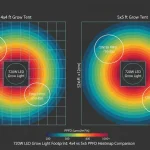
You set up an AeroGarden, drop in pods, add water…and then the questions start. Is the AeroGarden LED grow light “strong enough”? Why do some herbs explode with growth while a flowering plant stalls? The answer is usually not “more hours” or “more nutrients”—it’s understanding PAR and PPFD so you can place and run your AeroGarden LED grow light correctly for the plant you’re growing.

What an AeroGarden LED grow light is (and what it isn’t)
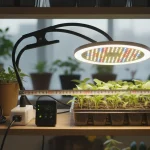
An AeroGarden LED grow light is a compact, integrated horticultural LED designed for small-footprint hydroponics and countertop planting. In practice, it’s optimized for leafy greens, herbs, and early-stage growth because the lamp is close to the canopy and the growing area is small. That “close range” design is why your height settings and pruning habits matter more than you’d expect.
It’s also not a universal replacement for high-output horticulture fixtures used in tents, vertical farms, or greenhouses. In my own testing with small hydro systems, the biggest mistake beginners make is assuming “bright to my eyes” equals “enough for fruiting/flowering.” Plant-light quality is measured with PAR-related metrics—not lumens or lux.
PAR vs PPFD (plain-English definitions)
PAR: the “usable light range” for photosynthesis
PAR stands for Photosynthetically Active Radiation—light wavelengths from 400–700 nm that plants can use for photosynthesis. PAR is a range, not an intensity number by itself. It answers: “Is this light in the right band for plants?”
Industry references consistently warn that human-vision metrics (lumens/lux) don’t describe plant-usable photons well, because plants and people “see” different wavelengths (Dimlux horticulture terms).
PPFD: the “how much light hits the plant right now”
PPFD (Photosynthetic Photon Flux Density) measures the number of PAR photons landing on a surface each second, in µmol/m²/s. PPFD answers: “How intense is the light at the leaf?” That’s why PPFD changes with height, plant growth, and even where you measure under the lamp.
If you want a simple explainer on why lux isn’t enough, Photone’s breakdown is a good reference point (PPFD vs lux).
The one formula that makes PPFD practical: DLI
PPFD is an instant reading. Plants respond to total light per day, called DLI (Daily Light Integral), measured in mol/m²/day. You can hit a decent DLI with moderate PPFD over more hours, or higher PPFD over fewer hours.
A standard conversion used by lighting calculators:
- DLI = PPFD × hours × 0.0036
You can confirm this relationship with established calculators like HLG’s PPFD to DLI conversion.
Typical PPFD targets (so you know what “enough” looks like)
Countertop gardens often grow mixed crops, so use target ranges as guardrails and then adjust based on plant response. Here are practical PPFD ranges widely cited for common categories (compiled from plant requirement references such as Grow Light Meter’s PPFD/DLI guides):
| Plant type / goal | PPFD “good starting range” (µmol/m²/s) | Typical DLI range (mol/m²/day) | Notes for an AeroGarden LED grow light |
|---|---|---|---|
| Seedlings / clones | 70–150 | 6–8 | Great match; keep lamp close but not bleaching |
| Leafy greens (lettuce, basil, herbs) | 150–300 | 10–18 | Sweet spot for most AeroGarden use-cases |
| High-light ornamentals (some orchids, sun-lovers) | 150–350+ | 8–18+ | May work if canopy stays close and plant fits the footprint |
| Fruiting/flowering crops (dwarf peppers, tomatoes) | 300–700 (varies widely) | 15–35 | Often the hardest in small systems; needs strong PPFD and good training |
Takeaway: The AeroGarden LED grow light is usually excellent for seedlings, herbs, and greens. Fruiting plants can work, but you’re more likely to be PPFD-limited as the canopy expands and shading increases.
 LED Lights and Plants: Myth-Busting Indoor Growth Facts.
Common disadvantages of LED grow lights (and how to avoid them)
People often say “LEDs are perfect,” but in real grows there are tradeoffs. The most common disadvantages show up when someone uses standard household LEDs or chooses a grow light without real horticulture data:
- Misleading brightness metrics: Lux/lumens can look high while PPFD is low for plants. Use PPFD/DLI thinking instead (Dimlux’s PAR/PPFD terminology).
- Hot spots at close distance: Even efficient LEDs can stress leaves when very close. With an AeroGarden LED grow light, this is mainly a distance and canopy-management issue.
- Coverage limits: Small fixtures can’t evenly cover large canopies. This is why pruning and spacing matter so much in countertop systems.
- Feature limits (dimming/spectrum control): Many integrated gardens are simple by design. For larger or more technical setups, dedicated fixtures with dimming and spectrum channels give more control.
If you’re comparing lighting technologies beyond countertop gardens, our internal comparison can help: Indoor LED Grow Light vs HPS: Which Wins Indoors?.
Quick crop guidance (hibiscus, Christmas cactus, and flowering colors)
What type of grow light for hibiscus?
Hibiscus is typically a high-light plant indoors. In a small hydro garden, it often becomes size- and light-limited. If you try it, aim for higher PPFD at the canopy, keep the plant trained small, and expect you may need a stronger dedicated fixture once it matures.
Is a grow light good for Christmas cactus?
Yes—Christmas cactus generally prefers bright, indirect light rather than intense midday sun levels. Moderate PPFD with a steady photoperiod usually works well. Watch for reddening/bleaching (too much light) vs limp, slow growth (too little light).
What two colors of light encourage flowering?
In simple terms: red + blue. Red plays a strong role in flowering signals, while blue supports structure and healthy leaf function. Many modern horticulture fixtures use broad “white” plus added deep red to balance growth stages.
“Has AeroGarden been discontinued?” and “Who bought out AeroGarden?”
Product availability changes over time by region and retailer, and brands may shift ownership or distribution. For the most accurate status on AeroGarden-branded grow lights and current availability, check the brand’s official product pages such as the AeroGarden grow lights listing hosted under Scotts Miracle-Gro (AeroGarden grow lights).
When to upgrade beyond an AeroGarden LED grow light (and what to look for)
If you consistently grow fruiting crops, want faster growth, or need better uniformity, you may outgrow countertop lighting. In ABEST’s ODM and project work at ProLEDGrowLight.com, the biggest performance jumps usually come from:
- Higher, verified PPFD maps (not just wattage claims)
- Better uniformity across the canopy
- Dimming + multi-channel control to match seedlings vs veg vs bloom
- Form factors (bars/boards/under-canopy) that match your space
A solid framework for choosing your next light is in our internal checklist: LED Grow Light Depot: Buyer’s Checklist for 2026.
How To Build a Diffuser for the Photone Grow Light Meter

Conclusion: use PAR & PPFD to make your AeroGarden predictably productive
Once you view your AeroGarden LED grow light through the lens of PAR, PPFD, and DLI, the guesswork drops fast. You’ll raise or lower the lamp with intent, set a photoperiod to hit a daily target, and choose crops that fit the system’s real light capacity. I’ve seen small gardens go from “leggy and slow” to “dense and harvestable” just by tightening canopy height control and aiming for the right DLI.
If you want, share what you’re growing and your light height/schedule in the comments—I’ll help you estimate a safe PPFD/DLI target and next steps.
📌 grow smarter not harder the led grow light bar that actually works
FAQ: AeroGarden LED grow light, PAR & PPFD
1) What does PPFD mean for an AeroGarden LED grow light?
PPFD tells you how much plant-usable light reaches your leaves at that moment. It changes a lot with light height and canopy density.
2) Is PAR the same as PPFD?
No. PAR is the wavelength range (400–700 nm). PPFD is the intensity of PAR photons hitting a surface (µmol/m²/s).
3) How many hours should I run an AeroGarden LED grow light?
Use hours to reach an appropriate DLI for your crop. Many herbs and greens do well around 14–16 hours, but adjust based on plant response.
4) Why do my plants get tall and leggy under my AeroGarden light?
Most often the canopy PPFD is too low (light too high, plants overcrowded, or shading). Lower the lamp and prune for a flatter canopy.
5) Can an AeroGarden LED grow light support flowering plants?
Sometimes, especially small ornamentals or compact varieties. Fruiting plants often need higher PPFD and better coverage than a countertop unit can provide.
6) Do lumens matter when choosing a grow light?
Lumens describe brightness to human eyes, not plant-usable photons. PPFD/PPF data is far more relevant for plant growth.
7) How do I convert PPFD to DLI?
Use DLI = PPFD × hours × 0.0036, or a trusted calculator like HLG’s conversion tool.