
If your plants could talk, they’d probably say: “Stop guessing my light.” The led grow light spectrum you choose decides whether seedlings stay compact or stretch, whether flowering triggers on time, and whether quality (color, aroma, nutrients) shows up at harvest. I’ve tested red/blue “blurple” fixtures, modern white full-spectrum bars, and multi-channel tunable rigs in tents and small rack setups—and the biggest mistakes I see are spectrum tunnel vision and ignoring intensity metrics like PPFD/DLI. This review breaks down what each spectrum actually does, when it wins, and how to choose without falling for marketing labels.

What “LED Grow Light Spectrum” Really Means (and what it doesn’t)
The led grow light spectrum is the distribution of wavelengths a fixture emits—commonly discussed across PAR (400–700 nm) and sometimes beyond into UV (below 400 nm) and far-red (700–800 nm). Spectrum alone doesn’t grow plants; it interacts with light intensity (PPFD), duration (photoperiod), and the plant’s target daily light integral (DLI). Fluence explains the practical difference: PPF is total photons emitted, while PPFD is what actually reaches your canopy at a point (μmol/m²/s) and is what your meter reads at plant level (Fluence guide).
To keep this review practical, I’ll evaluate spectra the way a grower experiences them:
- Structure: compact vs stretched, leaf thickness, node spacing
- Cycle control: veg speed, flowering behavior, uniformity
- Quality: color, secondary metabolites, “looks healthy” visibility under the light
- Efficiency + cost: photons per watt and fixture complexity
Red vs Blue vs Full Spectrum: What Each Color Band Does
Blue light (≈ 400–500 nm): compact growth and “control”
Blue is the steering wheel for morphology in many crops. In my racks, adding more blue consistently tightened internodes and improved “transplant-ready” structure, especially in leafy greens and clones. Research and extension guidance broadly align: blue helps inhibit extension growth that you commonly see under red-heavy lighting.
Where blue-heavy spectra shine
- Seedlings, clones, and leafy greens needing compactness
- Multi-layer vertical farming where height control matters
- Situations where you want thicker leaves and tighter nodes
Tradeoffs
- Too much blue can slow extension and sometimes reduce leaf expansion; growers then compensate with higher intensity or longer photoperiod.
Red light (≈ 600–700 nm): photosynthesis workhorse, but can stretch alone
Red photons are highly effective for driving photosynthesis, which is why early LED grow lights leaned red-heavy for efficiency. But red-only is notorious for causing undesirable stretch and thin leaves indoors. Michigan State University notes that plants under only red often look elongated; adding a relatively small amount of blue can dramatically improve compactness, with indoor mixes around 80–90% red and 10–20% blue commonly producing tighter plants (MSU PDF).
Where red-heavy spectra shine
- Flowering/fruiting energy delivery
- Supplemental greenhouse lighting (sun fills spectral gaps)
- Cost-sensitive builds where efficacy is prioritized
Tradeoffs
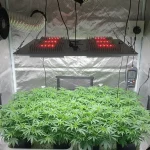
- Red-dominant “blurple” can make scouting harder (nutrient issues are harder to see) and can push stretch if blue is too low.
Green/yellow (≈ 500–600 nm): not “wasted,” helps penetration and balance
Older grow forums treated green as useless, but modern horticulture lighting recognizes it contributes to photosynthesis and canopy penetration. In practice, I notice full-spectrum white fixtures make it easier to spot deficiencies early—simply because plants look “normal” under the light, which improves day-to-day decisions.
Far-red (≈ 700–800 nm): a lever for canopy architecture and timing
Far-red can influence extension growth and leaf expansion; broad-spectrum fixtures may include some far-red output, and tunable fixtures can add it deliberately. The key is control: far-red can be beneficial, but it can also exaggerate stretch if your intensity, spacing, or blue fraction isn’t right. P.L. Light Systems also highlights far-red’s potential role in promoting stem extension and leaf expansion in broad spectra (P.L. Light Systems).
Review Verdict: Red/Blue (“Blurple”) vs Full Spectrum LEDs
1) Red/Blue fixtures: high efficiency, narrow comfort zone
Red/blue grow lights can be very photon-efficient because red and blue diodes have strong photon efficacy. P.L. Light Systems notes that red/blue systems are often recommended for greenhouse supplemental use, where sunlight already provides the missing wavelengths, and the fixture can focus energy on photosynthesis peaks (P.L. Light Systems).
My real-world take: In a greenhouse or sunlit hoop house, red/blue supplementation can be a smart energy play. In a sealed indoor tent where LEDs are the sole light source, I’ve found red/blue-only setups are less forgiving—plants can grow, but you give up visual comfort, spectrum balance, and sometimes consistency across stages.
2) Full spectrum LEDs: best “one light for the whole cycle”
Full spectrum (often white LEDs with added deep red) is generally easier for complete-cycle growing—seed to harvest—because it supplies a broader spread of wavelengths. P.L. Light Systems points out broad-spectrum LEDs may have lower efficacy than narrowband red/blue because of phosphor conversion losses, yet they often perform better in indoor applications where the luminaire is the only light source (P.L. Light Systems).
My real-world take: Full spectrum is what I recommend when you want stable outcomes across multiple crops or you’re still learning PPFD/DLI. It’s also the easiest lighting to work under for daily scouting.
3) Tunable “multi-channel” spectrum: best for pros who will actually use it
Adjustable fixtures (separate channels for blue/white/red/far-red) let you run a bluer recipe for seedlings, balanced white for veg, and red/far-red accents for flowering—if you have a plan and measurement habits. This is where ABEST’s ODM approach (custom spectrum + control system tuned per crop) is compelling for commercial operators who want repeatable recipes at scale.

Quick Comparison Table (What I’d buy for each scenario)
| Option | Best for | Pros | Cons | My verdict |
|---|---|---|---|---|
| Red/Blue (“Blurple”) | Greenhouse supplemental lighting; budget grows | High photon efficiency; strong photosynthesis peaks | Can stretch if blue is too low; poor visual scouting; less ideal as sole indoor source | Good supplement choice; niche as primary |
| Full Spectrum (white + deep red) | Indoor tents/rooms; mixed crops; seed-to-harvest | Balanced morphology; easier diagnosis; consistent across stages | Slightly lower efficacy than narrowband in some designs | Best default for most growers |
| Tunable Multi-Channel (blue/white/red/far-red) | Commercial/vertical farms; recipe-driven grows | Stage-by-stage control; crop-specific optimization | More complex; needs measurements and SOPs | Best if you’ll measure PPFD/DLI and standardize |
How to Choose the Best LED Grow Light Spectrum (without overthinking)
Step 1: Decide if sunlight is part of your system
This is the fork in the road.
- Greenhouse / mixed sunlight: red/blue supplementation can work well because the sun already delivers broad spectrum.
- Indoor / no sunlight: full spectrum is usually safer and more consistent.
Step 2: Use spectrum after you set intensity targets
I see growers obsess over diodes and ignore PPFD. Get your PPFD and DLI in range first, then fine-tune spectrum. If you want a metric refresher, your PPFD meter reads the light at canopy level, not what the fixture “claims” on the box (Fluence guide).
For practical setup help, ABEST’s audience often benefits from height and distribution guidance; this hanging reference is a useful starting point: Spectra LED Grow Light: Best Hanging Height Chart.
Step 3: Match spectrum to the plant’s “problem”
Use spectrum as a correction tool:
- Plants stretching: increase blue fraction, reduce far-red, or lower fixture distance only if PPFD remains appropriate.
- Plants too compact / slow leaf expansion: reduce blue fraction slightly, consider modest far-red, and verify temperature/VPD aren’t limiting.
- Flower set or timing inconsistent: ensure photoperiod is correct first; then consider red/far-red balance and uniform PPFD.
Step 4: If you buy adjustable spectrum, commit to a simple recipe
A tunable fixture is only “better” if you use it. I recommend starting with:
- Seedling/clone: higher blue, moderate overall intensity
- Vegetative: balanced white + adequate red
- Flowering: red-forward with controlled far-red
To avoid common dimming mistakes that quietly reduce yield, keep your workflow tight and measured. This guide is a good sanity check: LED Grow Light Review FAQ: PAR, PPFD, Heat, Cost.
ABEST / ProLEDGrowLight.com: Spectrum Design as a Manufacturing Advantage (Review angle)
Many brands sell “full spectrum” as a label; manufacturers who actually engineer spectrum treat it as a spec. ABEST (ProLEDGrowLight.com) has a clear advantage for commercial buyers because they do ODM spectrum design and project services—meaning the spectrum and control channels can be tailored to crop goals and facility constraints (vertical racks, under-canopy, greenhouse supplement, etc.). In projects I’ve seen succeed, the winning combo isn’t just spectrum—it’s spectrum + uniformity + controllability + a repeatable PPFD map.
If you’re comparing lighting layouts for multi-layer production, this is worth reading alongside spectrum decisions: Vertical LED Grow Light Deep Dive: Coverage, Heat, ROI.

Common Mistakes I See (and how to fix them fast)
-
Mistake: Buying “full spectrum” without checking what it includes.
Fix: Ask for the spectral distribution or at least CCT + deep red presence; verify PPFD maps. -
Mistake: Running red/blue as the only indoor light and fighting stretch.
Fix: Add blue or switch to full spectrum; verify plant spacing and intensity. -
Mistake: Confusing watts with usable light.
Fix: Compare fixtures by PPFD at canopy and PPF efficacy, not “equivalent watts.” -
Mistake: Overusing far-red because it “boosts growth.”
Fix: Treat far-red like a spice—small amounts, measured outcomes, stage-specific.
How to Choose the RIGHT Spectrum for Your Plants
Conclusion: The Best LED Grow Light Spectrum Is the One You Can Control and Repeat
The led grow light spectrum debate isn’t really red vs blue vs full spectrum—it’s about choosing a spectrum that matches your environment, then delivering it uniformly at the right PPFD/DLI. If you’re indoors and want the highest odds of success across crops and stages, full spectrum is the most reliable “set-and-win” option. If you’re supplementing sunlight in a greenhouse, red/blue can be an efficient tool. And if you’re operating commercially, tunable multi-channel spectrum (like the systems ABEST can ODM for specific crops) is powerful—provided you measure, document, and repeat.
📌 grow smarter not harder the led grow light bar that actually works
Authoritative references used:
- P.L. Light Systems: Full Spectrum Versus Red/Blue LED Grow Lights
- Michigan State University (PDF): Red Light and Plant Growth
- Fluence: How to Compare LED Grow Lights (PAR/PPF/PPFD)
FAQ: LED Grow Light Spectrum
1) What is the light spectrum for LED grow lights?
Most grow lights target PAR (400–700 nm) with varying amounts of blue, green/white, and red; some also include UV (<400 nm) and far-red (700–800 nm) for additional plant responses.
2) What is the best spectrum for LED grow lights?
For most indoor growers, a full-spectrum LED grow light (often around 5000K–6500K white plus deep red) is the most versatile across stages, with fewer morphology surprises than narrow red/blue.
3) Is red and blue LED really the most efficient for plants?
Red and blue diodes can be very photon-efficient, and red/blue fixtures can work extremely well as greenhouse supplemental lighting. Indoors as the only light source, full spectrum often gives more consistent whole-cycle results.
4) Why do plants stretch under red light?
Red-heavy or red-only lighting can trigger extension growth (longer stems, thinner leaves). Research-based guidance shows adding a modest amount of blue can reduce stretch and improve plant form.
5) Do I need UV in my LED grow light spectrum?
Not always. Small UV doses can influence secondary compounds in some crops, but it’s easy to overdo and stress plants. Prioritize correct PPFD/DLI and canopy uniformity before adding UV.
6) What spectrum should I use for flowering?
A red-forward spectrum commonly supports flowering/fruiting energy demand, but keeping some blue helps maintain structure. If using far-red, apply it deliberately and monitor stretch.
7) What lights do professional growers use?
Most pros use LED systems because they can choose spectral output and control intensity precisely—often full spectrum or tunable multi-channel fixtures paired with PPFD mapping and crop SOPs.