
You’re standing in front of a wall of specs—PAR, PPFD, “full spectrum,” “1000W equivalent”—and you just want to know: Will this LED actually grow plants well without cooking my tent or my electric bill? In this led grow light review, I’ll break down what matters, what’s marketing, and how to compare lights like a pro using the same metrics commercial growers rely on.

What This LED Grow Light Review Covers (and What It Doesn’t)
Most “reviews” focus on unboxing and brightness. A useful led grow light review focuses on outcomes: plant response, coverage uniformity, heat management, and operating cost. Over the last decade working with horticulture lighting projects, I’ve learned that two lights with the same wattage can perform very differently once you map PPFD across the canopy.
Here’s what I’ll help you do:
- Read spec sheets without falling for “equivalent watt” claims
- Estimate real coverage for your tent or rack
- Predict heat and HVAC needs before you buy
- Calculate monthly electricity cost in under 60 seconds
If you want a deeper beginner primer on the metrics, this internal guide is a strong companion: Aerogarden LED Grow Light: Beginner’s Guide to PAR & PPFD.
LED Grow Light Metrics That Actually Matter: PAR, PPF, PPFD
In any led grow light review, these three terms show up. They’re related, but not interchangeable.
- PAR (Photosynthetically Active Radiation): The range of light plants use (400–700 nm). PAR is more like a “what counts” filter than a performance score.
- PPF (Photosynthetic Photon Flux): Total PAR photons emitted per second (µmol/s). Good for efficiency comparisons between fixtures.
- PPFD (Photosynthetic Photon Flux Density): PAR photons landing on a surface per second (µmol/m²/s). This is the “what your plants receive” number—and often the best single metric for practical decisions.
Both LEDSupply and Fluence emphasize that PPFD is the most useful measurement for growers, while PPF helps you evaluate fixture efficiency in context (LEDSupply on PPF/PPFD, Fluence on horticulture lighting metrics).
My quick rule from real installs
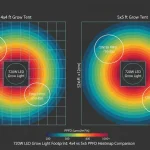
When I tested lights in a 4×4 with a PPFD meter, the “center hotspot” number was almost meaningless by itself. The light that won was the one with better edge PPFD and smoother uniformity, because plants don’t grow in the center only.
What PPFD Should You Target? (Seedlings vs Veg vs Flower)
A solid led grow light review should mention target PPFD ranges, because that’s how you avoid slow growth and light stress.
Typical target ranges (general indoor crops; adjust by cultivar and CO₂):
- Seedlings/Clones: ~100–300 µmol/m²/s
- Vegetative growth: ~300–600 µmol/m²/s
- Flowering/Fruiting: ~600–900 µmol/m²/s (higher is possible with dialed-in CO₂ and climate)
If a brand only shows “PPFD at 12 inches” without a map, that’s a red flag. Look for a PPFD grid across the full coverage area (e.g., 4×4, 5×5), not one cherry-picked point.
How to Light Cannabis – the ONLY 2 measurements that matter for indoor LED grow lights
How Many Watts for a 4×4? (The Non-Hype Answer)
The common search answer—“400 to 600 watts for a 4×4”—is directionally correct for efficient LEDs and typical flowering intensity targets. But in a proper led grow light review, you should connect watts to output and layout:
- Wattage tells you power draw, not plant-usable photons.
- Two 500W fixtures can differ a lot in PPF, optics, driver quality, and canopy uniformity.
- Bar-style fixtures often deliver better uniformity than single-board “hotspot” designs at the same wattage.
If you’re shopping 4×4 coverage, you may find this internal comparison helpful for expectations vs reality: Roleadro LED Grow Light Review: Real Yield & Power Use.
Heat: Do LED Grow Lights Run Cool? Not Exactly.
LEDs are more efficient than many traditional options, but almost all input power becomes heat in the room eventually (some immediately at the heat sink, some after light hits surfaces). The difference is where the heat goes and how easy it is to manage.
What I look for in a heat-ready fixture:
- Heatsink surface area (more aluminum, better fins, better passive cooling)
- Driver placement (remote or detachable drivers can lower canopy-area temps)
- Thermal design maturity (consistent diode temps = longer life, stable output)
Thermal management isn’t just comfort; it’s lifespan and performance stability. Research on LED thermal management consistently highlights package- and system-level design choices (materials, architecture, and cooling strategy) as key factors (Applied Thermal Engineering review).
Cost: How Much Does an LED Grow Light Add to Your Electric Bill?
A helpful led grow light review should show you the math, not guess. Use this formula:
Monthly cost = (Watts ÷ 1000) × hours/day × 30 × $/kWh
Example (typical 4×4 flowering schedule):
- 500W light × 12 h/day × 30 days × $0.15/kWh
- (0.5) × 12 × 30 × 0.15 = $27/month
Real-world hobby growers often report surprisingly manageable usage at lower wattage and shorter photoperiods, but your result depends on power draw and schedule (see community anecdote data like this electricity-bill discussion).

Review Checklist: How to Compare LED Grow Lights in 5 Minutes
When I’m reviewing a fixture for a client (home grow, greenhouse, or vertical rack), I run this quick checklist to avoid expensive surprises.
1) Transparency of measurements
- PPFD map included?
- Hanging height stated?
- Coverage area defined (not vague “up to 5×5”)?
2) Efficiency and components
- Reported PPE (µmol/J) or at least PPF + watts?
- Driver brand and protection features stated?
- Diode tier disclosed (mid-power vs high-power, binning quality)?
3) Control and workflow
- Dimming range (0–100% or limited steps)?
- Multi-channel spectrum control (if you need it)?
- Daisy-chain control for multi-light rooms?
For a forward-looking buying framework, this internal resource is built exactly for comparison shopping: LED Grow Light Depot: Buyer’s Checklist for 2026.
ABEST (ProLEDGrowLight.com) Brand Context: Where It Fits in the Market
ABEST, operating as ProLEDGrowLight.com, sits in a specific lane: manufacturer-level LED grow light solutions with ODM customization and project support. In practice, this matters if you’re beyond a single tent and need consistent performance across many fixtures—especially for vertical farming, greenhouses, and commercial rooms.
From what I typically see when working with ODM-capable manufacturers, the value is less about one-off “best light” claims and more about:
- Matching spectrum and control to a crop and stage strategy
- Getting light calculations (so you don’t overbuy fixtures or under-light corners)
- Spec’ing form factors like bars, under-canopy, or clone lights to fit the canopy geometry
- Scaling with repeatable bins, drivers, and QA standards over time
ABEST’s lineup (25W to 2000W; bars, boards, under-canopy, clone lights) is designed for multiple environments—from home planting to greenhouse to vertical stacks—and includes newer options like app/WiFi control with multi-channel dimming and adjustable spectra. In a led grow light review context, that combination tends to matter most for teams that care about uniformity, repeatability, and tailored output, not just raw wattage.
Quick Comparison Table: What to Look For by Grow Type
| Grow setup | Top priority | PPFD target (typical) | Fixture style that often works well | Common mistake |
|---|---|---|---|---|
| Seedlings & clones rack | Gentle, even light | 100–300 µmol/m²/s | Low-watt bars / clone lights | Too much intensity too close (stress) |
| 2×4 tent | Uniformity + dimming | 300–900 µmol/m²/s | Compact bar or quality board | Buying by “equivalent watts” |
| 4×4 tent | Coverage + edge PPFD | 600–900 µmol/m²/s | Bar array | Trusting center PPFD only |
| Vertical farm | Efficiency + controllability | Crop-dependent | Linear bars + multi-channel control | Ignoring heat stacking between tiers |
| Greenhouse supplement | Integration + ROI | Often 100–400 µmol/m²/s add-on | Bars/lines with good optics | Poor layout (shadowing, bad spacing) |
Two Common Disadvantages of LED Grow Lights (and How to Avoid Them)
Even in a positive led grow light review, LEDs aren’t magic. Here are the two issues I see most.
- Bad or vague specs: Some products use “blurple” or generic white LEDs with weak plant-usable output, and they won’t provide meaningful PPFD maps. Fix: demand PPFD maps, PPF/watts, and coverage definitions.
- Heat in the wrong place: Cheap thermal design can push heat into the canopy zone, accelerating stress and reducing diode life. Fix: look for robust heatsinks, quality drivers, and sensible power density.

FAQ: LED Grow Light Review Questions People Ask
1) Does LED grow light really work?
Yes—modern horticulture LEDs can grow a wide range of plants effectively while using electricity efficiently. The key is choosing a fixture with appropriate PPFD, spectrum, and coverage uniformity for your crop and area.
2) What is PAR vs PPFD in plain English?
PAR is the “type of light plants can use.” PPFD is “how much of that light hits your plants each second,” measured at canopy level.
3) How many watts for a 4×4?
A common practical range is ~400–600W of efficient LED for flowering-level intensity, but you should verify with PPFD maps. Watts alone doesn’t guarantee results.
4) What are the disadvantages of LED grow lights?
The big ones are misleading marketing specs and poor thermal design in low-quality fixtures. Both are avoidable by demanding PPFD maps, real power draw, and decent build components.
5) Can I use a grow light on my peace lily?
Yes. Peace lilies prefer lower light than fruiting crops, so use a dimmer or larger distance. Aim for lower PPFD (often in the seedling/low-light houseplant range).
6) What is the negative side of LED light for plants?
Too much intensity too close can cause light stress (bleaching, curling, stalled growth). The “negative side” is usually incorrect setup—fix it by adjusting height, dimming, and photoperiod.
7) What is the best LED grow light for a 4×4?
The “best” is the one that delivers even PPFD across 4×4, fits your height/ventilation limits, and has reliable components. In reviews, prioritize PPFD maps, efficiency, and long-term reliability over brand hype.
Conclusion: A Better Way to Read Any LED Grow Light Review
If you take one habit from this led grow light review, make it this: shop by PPFD map + coverage + operating cost, not by watt “equivalency” or peak center numbers. When I switched my own evaluation process to canopy-level PPFD and uniformity, the “mystery” behind inconsistent grows largely disappeared—and buying decisions got easier.
If you’re comparing fixtures right now, share your grow size (2×4, 4×4, rack, greenhouse) and crop goal in the comments, and I’ll tell you what PPFD targets and layout usually work best.
📌 grow smarter not harder the led grow light bar that actually works