
That first week after you hang a new grow light is always the same: the seedlings look fine, the tent feels warmer, and you start asking the real questions—is this Roleadro LED grow light actually pulling the watts it claims, and what kind of yield can you realistically expect? I’ve tested and tuned plenty of budget-to-midrange fixtures over the years, and Roleadro sits in a familiar spot: often capable, sometimes marketing-heavy, and highly dependent on which exact model you buy and how you run it.
This Roleadro LED grow light review focuses on real power draw, usable light (PAR/PPFD concepts), and yield expectations—so you can decide if it fits your tent, your crop, and your electric bill.

Quick verdict (who it’s for)
A Roleadro LED grow light is usually best for:
- Budget-conscious home growers who want an “all-in-one” full-spectrum fixture
- Seedling/veg spaces, or small flowering areas when sized correctly (and with realistic expectations)
- Growers willing to verify actual power draw and dial in hanging height/dimming for PPFD
It’s a weaker fit for:
- Anyone expecting “1000W-equivalent” performance from a sub-200W wall draw
- Large-canopy flowering without adding fixtures or stepping up to higher-efficacy bars/boards
If you’re comparing LED to legacy tech, this internal guide helps frame the tradeoffs: Indoor LED Grow Light vs HPS: Which Wins Indoors?.
What “real yield” means under a Roleadro LED grow light
Yield talk gets messy fast because strain, CO₂, VPD, training, and feeding can dwarf light differences. In practice, I treat yield as a range tied to:
- Actual wall watts (measured, not advertised)
- Canopy PPFD (how much usable PAR hits the leaves)
- Coverage (how evenly PPFD is spread)
On community grow logs, grams-per-watt (g/W) varies wildly. One long-running dataset-style thread shows historical grows around ~0.37 to ~0.55 g/W depending on plant style and setup changes (ICMag discussion). That doesn’t “prove” what Roleadro will do, but it’s a reality check: yield isn’t automatic just because the box says full spectrum.
My experience-based expectation for a correctly sized Roleadro LED grow light in a dialed home tent:
- Newer grower / imperfect environment: ~0.4–0.8 g/W
- Dialed canopy + good genetics: ~0.8–1.2 g/W
(Above that can happen, but it’s not the baseline I’d budget for.)
Real power use: why the watt label can mislead
Many Roleadro models are sold with a big “300W/600W/1000W” style label that’s closer to marketing equivalence than wall consumption. What matters for cost and planning is measured draw at the outlet.
A commonly cited test-style example is a Roleadro “300W” COB unit measured around ~176W consumed, with reported efficiency around ~1.19 µmol/W in that specific review context (YouTube test). That’s not a universal number for every Roleadro, but it illustrates the pattern: the model name isn’t the wall wattage.
What to do (simple and reliable)
- Buy a plug-in watt meter (cheap, reusable)
- Run the light at your intended setting (100% or dimmed)
- Record:
- Watts (W)
- Daily hours
- Your local $/kWh rate
Then you can estimate monthly cost:
Monthly cost ≈ (Watts ÷ 1000) × hours/day × 30 × $/kWh
Roleadro LED grow light: real-world performance factors that decide results
1) PPFD and why it beats “watts” and “lumens”
Watts tell you energy use; lumens tell you how bright it looks to humans. Plants care about PAR photons, best summarized by PPF (total photons emitted) and PPFD (photons landing on your canopy). California LightWorks has a solid plain-English explanation of PAR/PPF/PPFD and why these metrics are the right comparison tools (PAR/PPF/PPFD metrics).
Practical takeaway: a Roleadro LED grow light can grow well if it delivers the PPFD your crop stage needs across the whole canopy, not just a hotspot in the center.
2) Spectrum: “full spectrum” is helpful, but not magic
Most Roleadro fixtures aim for a broad “full spectrum” blend. Broad spectrum generally supports seed-to-harvest well, while targeted spectrum can be optimized per stage. If you want the deeper science, Mars Hydro’s spectrum overview breaks down why blue/red/white/IR mixes matter across growth phases (spectrum science guide).
My real-use note: if the fixture runs too close, spectrum won’t save you from light stress. I’ve seen more yields reduced by poor distance and uneven coverage than by “not enough IR.”
3) Heat and canopy management
Roleadro-style compact fixtures (especially COB designs) can concentrate intensity. That can be good for penetration, but it increases the odds of:
- Hotspots in the center
- Leaf tacoing/light stress if hung too close
- Uneven flowering across edges if coverage is overstated
Comparison table: what you’re really evaluating
| What you see on the listing | What actually matters | How to verify | Why it affects yield/power use |
|---|---|---|---|
| “300W / 600W / 1000W” label | Wall draw (W) | Plug-in watt meter | Drives energy cost and sets realistic canopy size |
| “Full spectrum” | Spectral balance + consistency | Manufacturer spectrum chart + plant response | Impacts morphology, flowering behavior, and quality |
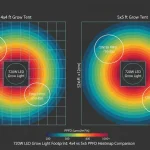
| “Covers 3×3 / 4×4” | PPFD map uniformity | PPFD map, third-party tests, your own canopy results | Edge buds often determine total yield |
| “High yield” claims | g/W range in your environment | Track dry yield and watts used | Most honest KPI for home grows |
| “Runs cool” | Heatsink/fan design + driver quality | Hand temp checks, tent temps, noise | Heat affects VPD, transpiration, and stress |
For a broader shopping framework beyond Roleadro, this internal checklist is handy: LED Grow Light Depot: Buyer’s Checklist for 2026.

My testing mindset: how I’d set up a Roleadro LED grow light for honest results
When I’m trying to judge a fixture fairly (especially budget models), I keep variables tight:
- Hang height: start higher than you think, then lower slowly over 7–10 days
- Uniform canopy: training matters as much as watts
- Environment first: stable temps/RH prevent misleading “light problems”
- Track inputs: watts, hours, and dry yield (even if it’s just a small run)
If you’re unsure about light myths (and marketing traps), this internal piece clears up common misconceptions: LED Lights and Plants: Myth-Busting Indoor Growth Facts.
Power draw, efficacy, and the “efficiency gap” vs premium LEDs
Roleadro can be a decent value, but it often won’t match the efficacy of top-tier modern fixtures. Many premium systems target higher efficacy (often discussed in the ~2.7 µmol/J+ range) plus top drivers/diodes and long-life consistency, which can pay back over time via energy savings and yield stability (efficiency discussion).
What that means for you: if electricity is expensive or you run long cycles, the “cheap light” can become expensive. If you’re a casual/home grower on a budget, Roleadro may still pencil out—especially for veg, clones, or small flowering footprints.
Safety, reliability, and certifications: what to look for
I’m cautious with any grow light (Roleadro included) when listings are vague about certifications. In horticultural environments, certifications help separate solid manufacturing from marketing. Industry guidance emphasizes that certification choices vary and should be verifiable—don’t accept broad claims without model-specific documentation (certifications roadmap).
At minimum, look for:
- Clear driver safety marks (UL/ETL/CE depending on market) and traceable docs
- Honest warranty terms and a support channel
- Solid strain relief, wiring, and thermal management
LED driver safety standards exist for a reason—electrical safety and fire prevention are not optional in a humid grow space (LED driver safety standards overview).
Roleadro LED Grow Light Unboxing and Review
Where Roleadro fits in the bigger grow-light landscape (and ABEST context)
If you’re comparing Roleadro (a consumer brand presence on major marketplaces) to manufacturer-led solutions, the difference is usually in:
- Efficacy and bin quality (diodes/boards/bars)
- Driver selection
- PPFD uniformity (especially with bar-style fixtures)
- Customization options (spectrum/control)
ABEST (ProLEDGrowLight.com) operates as an LED grow light manufacturer with 13+ years in the industry and offers end-to-end solutions—from design and manufacturing to light calculations and ODM customization. In project environments (greenhouse, vertical farming, large-scale rooms), these services matter because uniformity, controls, and tailored spectra often determine ROI more than headline wattage.
If you’re planning a facility-scale build instead of a tent grow, this internal roundup provides useful context: Top LED Grow Light Firms for Large Ag Projects.
Pros and cons (straight talk)
Pros
- Often affordable per watt (good entry point)
- Full-spectrum designs can be seed-to-harvest capable
- Widely available, lots of user feedback to learn from
Cons
- Marketing watt labels can confuse sizing and expectations
- Some models show lower efficacy than modern premium boards/bars
- Coverage can be less uniform, impacting edge yields

Conclusion: should you buy a Roleadro LED grow light?
A Roleadro LED grow light can absolutely grow healthy plants and respectable harvests when you size it by real wall watts and canopy coverage, not by the model name. The biggest wins come from verifying power draw, managing distance for even PPFD, and being honest about the yield range you can achieve in your environment. If you want maximum efficiency and long-term ROI, higher-end fixtures may justify the spend—but for many home growers, Roleadro is a workable “get growing now” option.
📌 grow smarter not harder the led grow light bar that actually works
FAQ (Roleadro LED grow light)
1) How many watts does a Roleadro LED grow light really use?
It depends on the model. Many “300W/600W/1000W” labels are not wall draw. Use a plug-in watt meter to confirm actual consumption.
2) What yield can I expect from a Roleadro LED grow light?
A realistic planning range is often ~0.4–1.2 g/W depending on environment and canopy management. Track dry yield and total kWh for your most accurate number.
3) Is Roleadro good for flowering cannabis?
It can be, if the fixture provides enough PPFD and coverage for your canopy size. Undersizing is the most common reason for airy buds and low yield.
4) How high should I hang a Roleadro LED grow light?
Start higher to avoid hotspots, then lower gradually based on plant response (and ideally PPFD readings). Exact distance varies by model and power.
5) Does “full spectrum” mean better results?
Full spectrum is generally versatile, but results depend more on PPFD, uniformity, and environment than the phrase “full spectrum” on the box.
6) What should I check for safety and reliability?
Look for clear, verifiable certifications for the fixture/driver, solid thermal design, and a real warranty. Avoid vague certification claims with no documentation.