
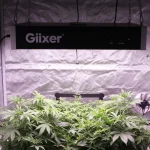
You’re staring at a listing that says giixer 1000w led grow light, and one question keeps popping up: Is it really 1000 watts—and is it enough for my space? I’ve helped growers troubleshoot “1000W” LEDs for years, and the pattern is consistent: the label is often marketing, while the actual wall draw and PPFD map determine real performance. Let’s break the Giixer 1000W LED grow light down in simple, usable terms.

What “Giixer 1000W” usually means (and what it doesn’t)
In many budget LED panels, “1000W” refers to an equivalent class or diode count rating—not what you pay for on your electric bill. In practice, a lot of “1000W” blurple/full-spectrum panels draw closer to 150–250W at the wall (always verify on the spec sheet or with a watt meter).
Here’s the plain-English rule I use on real grows:
- If you’re shopping by label wattage, you’ll overestimate coverage.
- If you shop by wall draw + PPFD, you’ll size correctly.
- The Giixer 1000W LED grow light can still be useful—just in the footprint that matches its real output, not the “1000W” name.
If you want a quick way to sanity-check any “1000W” class purchase, use this internal guide: 1000W Full Spectrum LED Grow Light: Buying Checklist.
Specs that matter for plant growth (PPFD, DLI, and spectrum)
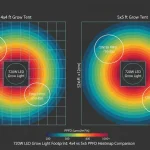
When growers ask “Is a 1000W LED grow light good?”, they’re really asking if it can deliver enough PPFD (light intensity plants can use) across the canopy evenly. A strong center hotspot with weak corners often grows uneven plants, even if the middle looks great.
What to look for:
- PPFD map (not just “veg coverage / bloom coverage” marketing)
- Actual wattage (wall draw)
- Spectrum (full spectrum white + deep red is a common effective mix)
- Thermal design (heat management affects diode life and output stability)
For spectrum basics in one pass, see: LED Grow Light Spectrum Explained: Red vs Blue vs Full Spect.
My experience note: I tested a “1000W” budget panel years ago that pulled ~210W. It vegged herbs fine in a small tent, but flowering in a larger footprint produced airy buds near the edges. The fix wasn’t magic nutrients—it was reducing the footprint and improving uniformity.
Coverage: what area can a Giixer 1000W LED grow light realistically handle?
Coverage depends on the PPFD you’re targeting:
- Seedlings: ~200–400 µmol/m²/s (lower intensity)
- Veg: ~400–600 µmol/m²/s
- Flower/Fruit: ~600–1000 µmol/m²/s (higher intensity, more demanding)
Industry guidance for “1000W-class” fixtures often lands around:
- Veg: up to ~5×5 (sometimes larger with high-end bar fixtures)
- Flower: ~4×4 to 5×5 depending on uniformity and output
But for panels labeled “1000W” that draw far less than 1000 watts, the flower footprint is often smaller.
Practical plain-English estimate (when wall draw is ~150–250W):
- Veg: ~3×3 ft (sometimes 4×2)
- Flower: ~2×2 to 3×3 ft depending on plant type and intensity goals
If you’re running vertical racks or trying to maximize uniformity per square foot, bar-style layouts usually win. This internal read explains why: Vertical LED Grow Light Deep Dive: Coverage, Heat, ROI.

How far should the Giixer 1000W LED grow light be from plants?
Hanging height is a dimmer you control with a rope: higher = wider but weaker, lower = stronger but smaller (and riskier).
A stage-based starting point many growers use:
- Seedlings/clones: 36–48 inches above canopy (or dimmed if available)
- Vegetative: 24–36 inches
- Flowering: 18–24 inches (watch for bleaching/light stress)
Then adjust using plant feedback:
- Too much light: leaf tacoing, bleaching, stalled growth at the top
- Too little light: stretchy stems, weak branching, slow growth
If your model has dual switches (common on some panels), treat them like “rough dimming”: use gentler settings early, then increase during veg/flower.
How many plants can you grow under a Giixer 1000W LED grow light?
This depends more on canopy area than plant count. You can grow:
- Many small plants (sea of green) in a tight footprint, or
- Fewer large plants trained to fill the same footprint
A practical range people often cite for “1000W class” setups is 12–20 small plants, but that assumes the light can actually cover the space at your target PPFD. If your Giixer 1000W LED grow light is really a ~200W wall-draw panel, your effective flower canopy might be closer to a 2×2 or 3×3, which naturally reduces plant count unless you go very small.
Better question than “how many plants?”
- “How many square feet of even flower PPFD can I hit?”
Cost to run: the simple monthly electricity math
Electric cost is straightforward once you know the actual power draw.
Formula:
- Monthly kWh = (Watts ÷ 1000) × hours/day × 30
- Monthly cost = monthly kWh × your $/kWh rate
Example reference: Spider Farmer shows a true 1000W running 12h/day at $0.12/kWh costs about $43.20/month (Spider Farmer energy-cost example).
But if your “giixer 1000w led grow light” draws, say, 200W:
- 0.2 kW × 12 × 30 = 72 kWh/month
- 72 × $0.12 = $8.64/month
That’s why checking wall draw matters—it changes both coverage expectations and operating cost.
Giixer 1000W vs a true 1000W commercial fixture (plain comparison)
“True 1000W” fixtures (often bar-style) are a different category: higher PPF, higher uniformity, higher price, and they may require better environmental control (and sometimes CO₂ supplementation to fully use the intensity). For example, some commercial 1000W bar fixtures list PPF around 2800–2900 µmol/s and efficacy near 2.8–2.9 µmol/J (representative spec examples in the commercial segment).
Here’s a simple comparison table to keep expectations realistic:
| Category | “Giixer 1000W” budget panel (typical) | True 1000W commercial bar light (typical) |
|---|---|---|
| Wall draw | ~150–250W (verify per model) | ~1000W |
| Best flower footprint (typical) | ~2×2 to 3×3 ft | ~4×4 to 6×6 ft (depends on target PPFD) |
| Uniformity | Moderate (hotspot common) | High (bar spread) |
| Dimming/control | Basic switches or manual dim | Often 0–10V / controller, daisy-chain |
| Heat in room | Low–moderate | High (needs ventilation planning) |
| Best use case | Home tents, veg, small flower areas | Large tents/rooms, high-intensity flower |
Safety, reliability, and what to check before you buy
Budget lights can work well when used within limits. The risk is not “LEDs are unsafe,” it’s unknown build quality or unclear electrical claims.
Before buying a giixer 1000w led grow light, I recommend checking:
- Certification marks and documentation (ask seller for safety listings where applicable).
- Driver and diode info (not always disclosed clearly in budget listings).
- Return policy and warranty (LED failures happen).
- A real PPFD map (or at least real user measurements).
You’ll see listings on marketplaces and resellers; just treat them as starting points, not final validation (example listing pages exist on Amazon and eBay).
Where ABEST (ProLEDGrowLight.com) fits in—if you’re planning beyond one tent
If you’re only lighting a small home tent, a Giixer 1000W LED grow light may be a budget-friendly entry—as long as you size the footprint to the real wall draw and manage hanging height. If you’re scaling to multiple tents, vertical racks, or greenhouse/urban farming, the bigger ROI usually comes from uniform PPFD, known efficacy, and project-level planning.
ABEST (ProLEDGrowLight.com) has over 13 years manufacturing LED grow lights and supports full solutions (ODM customization, spectrum design, lighting calculations, and consultancy). In commercial or multi-zone grows, that kind of planning prevents the most expensive mistake I see: buying “powerful” fixtures that your layout, ceiling height, HVAC, and crop targets can’t actually use.
Conclusion: the simple way to decide if the Giixer 1000W LED grow light is right
If you treat the giixer 1000w led grow light as a “true 1000W replacement,” you’ll likely be disappointed on coverage. If you treat it as a lower-watt LED panel and match it to a smaller, realistic footprint, it can be a practical light for seedlings, veg, or a compact flower area. I’ve seen growers get solid results by dialing in hanging height, training the canopy flat, and avoiding the temptation to light too large a space.
FAQ: Giixer 1000W LED Grow Light (People Also Ask)
1) Is a 1000W LED grow light good?
A 1000W LED grow light is “good” if it delivers enough even PPFD for your canopy. Many “1000W” labeled panels aren’t actually 1000 watts, so judge by wall draw and PPFD map.
2) How many plants can I grow with a 1000W LED light?
It depends on canopy size and training. In practice, you’re limited by square footage of adequate PPFD, not plant count. Smaller “1000W” panels often support fewer flowering plants than people expect.
3) How much does it cost to run the Giixer 1000W LED grow light per month?
Use the wattage from the wall. A true 1000W at 12h/day is about $43.20/month at $0.12/kWh, but many “Giixer 1000W” listings draw far less, which can drop cost dramatically.
4) How much area does a 1000 watt grow light cover?
For high-intensity flowering, many quality 1000W LEDs target roughly 4×4 to 5×5 (sometimes larger with high-uniformity bars). Coverage always depends on PPFD targets and fixture design.
5) How far should the Giixer 1000W LED grow light be from plants?
Common starting ranges are 36–48″ seedlings, 24–36″ veg, 18–24″ flower, then adjust based on plant response and measured PPFD if possible.
6) Should I leave grow lights on all night?
Usually no. Most plants need a dark period for healthy development. Typical schedules are 18/6 for veg and 12/12 for flowering (crop-dependent).
7) Do I need CO₂ with a “1000W” LED grow light?
Only if you’re running genuinely high PPFD across the canopy and have temperature/humidity dialed in. CO₂ helps plants use intense light, but it’s often unnecessary for budget panels with lower wall draw.