
You’re standing in front of a product page that says “1000w full spectrum led grow light,” and it sounds like a guaranteed monster harvest. Then you notice tiny-print specs like “actual draw: 220W,” vague “coverage,” and no real PPFD map. I’ve been there—early in my career I bought a “1000W” fixture for a small room, only to learn the label often means “HPS equivalent,” not wall power, and my environment couldn’t keep up with the intensity. This how-to checklist will help you buy (and run) a 1000w full spectrum led grow light using the metrics commercial growers use: PPFD, PPF, efficacy, uniformity, and safety.

Step 1) Confirm what “1000W” really means (label vs. wall draw)
The first rule: don’t shop by “watts” on the nameplate alone. Lighting scientists and top horticulture brands compare fixtures by PPF, PPFD, and photon efficacy (µmol/J)—because light grows plants, not electrical watts by itself. Fluence explains why watts are a poor comparison metric and why you should ask for output and distribution data instead of marketing claims (Fluence: how to compare grow lights).
Use this quick verification method:
- Find “Power Draw / Input Power” (true wall consumption). Many “1000W” listings are actually 150–250W.
- Find PPF (µmol/s) and efficacy (µmol/J). If PPF is missing, you’re buying blind.
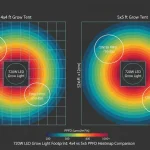
- Ask for a PPFD map at a stated hanging height and area (e.g., 5’x5’ at 12–18″).
Rule of thumb: a true 1000W fixture (≈1000W draw) is usually for serious 5’x5’ flowering—or bigger—when paired with strong environmental control.
Step 2) Match the 1000W full spectrum LED grow light to your grow area (coverage + uniformity)
Coverage isn’t a single number; it changes with hanging height, optics, and how even the canopy is lit. A “5’x5’ coverage” claim is only meaningful when you know the target PPFD (veg vs. flower) and the uniformity across that footprint.
Practical targets most growers use:
- Seedlings/Clones: ~100–300 µmol/m²/s
- Vegetative: ~300–600 µmol/m²/s
- Flowering/Fruiting: ~600–1000+ µmol/m²/s (often higher with CO₂)
A 1000w full spectrum led grow light that can technically cover 5’x5’ may only do it at veg intensity unless it has strong output and good spread (bar-style fixtures typically help). If you want a deeper framework for sizing by coverage and ROI, see Vertical LED Grow Light Deep Dive: Coverage, Heat, ROI.

Step 3) Use the right specs: PPF, PPFD, DLI, and efficacy (the “real” checklist)
If a listing pushes “LED brand” or “1000W equivalent” but hides PPFD data, treat it as a red flag. The minimum spec set I require before I’ll recommend a fixture (or spec one into a project) is:
- PPF (µmol/s): total PAR photons produced (output)
- Efficacy (µmol/J): photons per joule (efficiency). High-end fixtures commonly target 2.7–3.0+ µmol/J in premium segments, which can reduce operating costs over time (Gorilla Grow Tent: efficiency guide).
- PPFD map: distribution across the canopy (performance)
- Thermal strategy: heat sinks, driver placement, airflow needs
- Dimming behavior: smooth range, stable spectrum when dimmed, external control option
For a clear definition of these terms (and why a single PPFD reading isn’t enough), Fluence’s metric overview is a solid reference (PAR/PPF/PPFD metrics).
Step 4) Choose a spectrum that fits your crops (and avoid “mystery full spectrum”)
“Full spectrum” should mean a balanced white base (often with 3000K/4000K blend) plus targeted deep red—sometimes far red—depending on goals. For many leafy greens and general indoor farming, a stable full spectrum is enough. For high-intensity flowering crops, spectrum tuning can improve morphology and flowering response, but only if your environment and feed program are dialed in.
What I look for in a 1000w full spectrum led grow light spectrum spec sheet:
- Spectrum chart (SPD) with wavelength distribution
- Red (around 660 nm) presence for flowering support
- Optional far red (around 730 nm) if you understand the trade-offs (stretch vs. finish)
- If it’s multi-channel, confirm channels are independently dimmable and repeatable
If you want a deeper explanation of full spectrum vs. red/blue mixes, this internal guide is helpful: LED Grow Light Spectrum Explained: Red vs Blue vs Full Spect.
Step 5) Decide on fixture style: bars vs boards (for 1000W class, it matters)
In real rooms, distribution is everything. In 1000W class fixtures, bar designs often win on uniformity and canopy penetration because they spread diodes over a larger area and reduce hot spots.
Quick comparison:
| Feature | Bar-Style 1000W Fixture | Board-Style “1000W Class” Fixture |
|---|---|---|
| Canopy uniformity | Typically higher (more even PPFD) | Can be uneven if compact |
| Heat distribution | Better spread, cooler hotspots | More concentrated heat zones |
| Best for | 5’x5’ and larger, commercial/serious hobby | Smaller footprints, budget builds |
| Hanging height flexibility | More forgiving | Often more sensitive |
| Expansion/modularity | Easier to scale in rows | Less modular |
Step 6) Verify safety and compliance (don’t skip this)
A powerful 1000w full spectrum led grow light is a high-current device running long hours in humid environments. You want credible safety marks and quality drivers.
Checklist:
- ETL/UL listing (or equivalent) for the fixture/driver where applicable
- Surge protection and proper grounding
- IP rating if you’re in a greenhouse or high-humidity grow
- Quality driver (reliable thermal performance, stable dimming)
Many commercial buyers filter listings by ETL/UL-type compliance because it reduces risk and simplifies installation approvals. If a supplier won’t provide documentation, move on.
Step 7) Calculate monthly operating cost (and plan your heat removal)
Electricity cost surprises buyers—especially when they purchase a true high-draw unit. Use this formula:
Monthly kWh = (Watts ÷ 1000) × hours/day × 30
Monthly cost = kWh × your $/kWh rate
Example for a true 1000W draw:
- Flower schedule: 12 hours/day
- kWh: (1000/1000) × 12 × 30 = 360 kWh/month
- At $0.12/kWh → $43.20/month (one light)
If you run 16 hours/day (veg), it jumps to 480 kWh/month → $57.60/month at $0.12/kWh.
If you want a plug-and-play way to do this for any schedule and rate, use: LED Grow Light Electricity Usage Calculator: kWh & Cost.
Step 8) Set it up like a pro (hanging height, dimming, and measurement)
A 1000w full spectrum led grow light can be incredible—or it can bleach tops and waste power—depending on setup. The fastest way to get it right is to measure.
How-to setup workflow (what I do on installs):
- Hang higher than you think on day one (reduces hotspots).
- Start dimmed (especially for seedlings/veg) and raise intensity weekly.
- Measure PPFD in a grid across the canopy (corners matter).
- Aim for uniformity first, then chase peak intensity.
- Adjust environment (temp/RH/CO₂) to match higher light, not the other way around.
If you’re using a dimmer, avoid common yield-killing mistakes like over-dimming late flower or running too intense too early. This internal guide is worth skimming: LED Grow Light Dimmer: 7 Mistakes That Hurt Yields.
How to Light Cannabis – the ONLY 2 measurements that matter for indoor LED grow lights
Step 9) Answer the big buying questions (plants, “is it good,” and realistic expectations)
How many plants can I grow with a 1000W LED light?
Plant count depends more on canopy area and training style than the wattage label. In a well-run 5’x5’, many growers fit 12–20 smaller plants (SOG style) or fewer larger plants trained wide. If your 1000w full spectrum led grow light is truly high output, you’ll be limited by spacing, airflow, and your ability to maintain uniform PPFD across the canopy.
Is a 1000W LED grow light good?
It’s “good” when:
- You have enough space (often 5’x5’ or larger)
- You can manage heat and humidity
- You’re selecting by PPFD/PPF/efficacy and not marketing watts
For many home tents, 600–800W high-efficacy fixtures can be the sweet spot. A true 1000W draw is often a commercial move unless you’re pushing high-intensity flowering.
What is the coverage of a 1000 watt LED grow light?
Most quality 1000W-class bar fixtures target a 5’x5’ flower footprint, but the only honest answer comes from a PPFD map at a stated hang height. If a brand can’t provide that, coverage claims are guesswork.
Step 10) When to consider ODM/custom (ABEST / ProLEDGrowLight.com perspective)
If you’re buying for a facility, reselling, or building a repeatable cultivation recipe, customization matters. ABEST (ProLEDGrowLight.com) has spent 13+ years manufacturing LED grow lights and supporting projects with light calculations, spectrum planning, control systems, and ODM customization—including adjustable spectra, multi-channel dimming, and App/WiFi control options for different growth stages.
Where ODM tends to pay off:
- You need a specific spectrum for a crop (greens vs medicinal vs propagation)
- You want a consistent bill of materials for scaling
- You need branding/appearance customization for retail channels
- You’re optimizing for uniformity in vertical or greenhouse layouts
If you’re comparing many “1000w full spectrum led grow light” options across brands and want a broader shopping framework, this internal reference aligns well with the checklist approach: LED Grow Light Depot: Buyer’s Checklist for 2026.

Quick “Buy/No-Buy” checklist (printable)
Buy if you have:
- Real power draw disclosed
- Published PPF + efficacy (µmol/J)
- A full PPFD map with height and footprint
- Dimming + optional external control
- Clear warranty and safety documentation
No-buy if:
- “1000W” is the only meaningful spec
- No PPFD map, no PPF, no efficacy
- Coverage claims don’t state growth stage or target PPFD
- Unverified safety claims or vague warranty terms
For a broader, industry-standard overview of LED buying factors, see LED Grow Lights: The Ultimate 2026 Buyer’s Guide.
Conclusion: Buy the light that fits your room, not the hype
A 1000w full spectrum led grow light can be a powerhouse—but only when it’s sized by PPFD and uniformity, backed by real photometric data, and matched to an environment that can carry that intensity. The best results I’ve seen (and helped clients achieve) came from treating the light as part of a system: fixture + layout + dimming plan + HVAC/dehumidification. If you’re stuck between two models, ask for the PPFD map and the real power draw; the better light usually reveals itself fast.
📌 grow smarter not harder the led grow light bar that actually works
FAQ (People Also Ask)
1) Is a “1000W” LED grow light really 1000 watts?
Often no. Many products use “1000W” as an equivalency label. Always check actual power draw and ask for PPF/PPFD data.
2) What PPFD should I aim for with a 1000W full spectrum LED grow light?
Common targets are ~300–600 for veg and ~600–1000+ for flower, depending on crop, CO₂, and environment.
3) How many plants can a 1000W full spectrum LED grow light grow?
Typically it’s determined by canopy area (often a 5’x5’). Many growers run 12–20 smaller plants or fewer larger trained plants.
4) What’s better for 1000W: LED bars or boards?
Bar fixtures usually provide better uniformity and spread in 5’x5’ footprints, which helps yield consistency.
5) How much does it cost to run a true 1000W LED grow light per month?
At 12h/day, about 360 kWh/month. Multiply by your electricity rate (e.g., $0.12 → ~$43/month).
6) Do I need CO₂ with a 1000W fixture?
Not always, but at higher PPFD levels, CO₂ and strong environmental control can help plants use the extra light efficiently.
7) What certifications should I look for?
Look for credible safety compliance (often UL/ETL-type listings), clear driver specs, and a real warranty from an established manufacturer.