
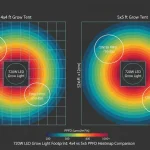
You bought a solid LED fixture, hung it straight, and your plants still look “off.” In my experience auditing indoor rooms, the culprit is often the LED grow light dimmer—not because dimming is bad, but because it’s easy to use it in ways that silently cut DLI, flatten growth, or trigger stress. So how do you dim “on purpose,” not “by feel,” and keep yields moving up?
This how-to guide breaks down the most common dimmer mistakes I see (and how to fix them) using practical PPFD/DLI logic, canopy uniformity basics, and driver compatibility checks.

Why an LED grow light dimmer matters (more than most growers think)
A LED grow light dimmer changes photon output, which changes PPFD (instant intensity) and DLI (daily total light). PPFD is what your leaf “feels” right now; DLI is what the plant “remembers” over the day. When you dim without measuring, you’re basically guessing your DLI—and yields rarely reward guessing.
Good dimming also helps you:
- Prevent light stress after transplant or flip
- Improve uniformity by raising fixtures and dimming slightly
- Match intensity to CO₂, temperature, and cultivar tolerance
If you’re brushing up on the metrics, this internal refresher is helpful: LED Grow Light Review FAQ: PAR, PPFD, Heat, Cost.
The quick “how-to” baseline: dim with targets, not percentages
Percent on a dial is not a crop target. Two fixtures at “60%” can deliver very different PPFD, depending on optics, height, and layout.
Do this in order
- Pick a DLI goal for the stage (seedling/veg/flower) based on your crop and environment.
- Set your photoperiod (hours/day).
- Measure PPFD at the canopy (multiple points, not just center).
- Adjust height for uniformity, then use the LED grow light dimmer to hit your PPFD target.
- Re-check after 24–48 hours, because plants “tell the truth” with posture and leaf temperature.
For measurement, a dedicated PAR meter is ideal, but reputable tools and methods exist; Photone’s metric overview explains PPFD/DLI clearly: Grow Light Metrics Explained.

7 LED grow light dimmer mistakes that hurt yields (and the fixes)
1) Dimming by “plant color” instead of PPFD + DLI
Leaves can look fine while your DLI is too low, especially in early veg. I’ve seen rooms stuck at ~60% power simply because nothing looked “burned,” yet growth stayed slow and internodes stretched.
Fix
- Measure PPFD across the canopy (at least 9 points in a small tent; more in a room).
- Convert to DLI using your photoperiod, then adjust the LED grow light dimmer to hit the target.
Good practical reading on PPFD/DLI planning: PPFD & DLI Guide.
2) Big intensity jumps (or frequent fiddling)
Plants acclimate to light. Sudden changes in intensity or height can cause stress responses—wilting posture, tacoing, slowed growth—especially when other factors (VPD, EC) don’t match the new light level. Manufacturers commonly warn against changing intensity too fast for a reason.
Fix
- Change intensity gradually: aim for 5–10% steps every 24–48 hours (or smaller if plants are already stressed).
- If you must change fast (heat emergency), reduce intensity and correct temperature/airflow first, then re-ramp.
3) Chasing high center PPFD while ignoring uniformity
A classic yield killer: blasting the middle while corners starve. The dimmer “solves” hotspots, but only if you also set height and layout for even distribution.
Fix
- Raise the fixture to improve spread, then use the LED grow light dimmer to bring average PPFD back to target.
- Map PPFD and look at min/avg (not only max). Uniformity is a direct driver of consistent canopy and predictable output.
Uniformity fundamentals are well summarized here: improve grow light uniformity & mounting height.
4) Using the wrong dimmer type (driver compatibility mismatch)
Not all dimmers speak the same language. Common dimming methods include:
- 0–10V (industry standard in commercial horticulture)
- PWM (pulse-width modulation)
- Resistance/potentiometer (often via a specific driver input)
- Digital controls (RJ ports, app/WiFi, RS-485, proprietary)
A mismatch can cause flicker, limited dim range, or instability—bad for plants and sometimes bad for drivers.
Fix
- Confirm the driver’s dimming spec (e.g., 0–10V sink/source requirements, PWM frequency, allowed current).
- Use manufacturer-approved controllers for multi-fixture daisy chains.
- For project builds, require documentation aligned with horticultural lighting requirements and safety certification guidance like DLC’s technical requirements: DLC HORT Technical Requirements (V3.0 PDF).
5) Dimming down to “solve heat,” but not fixing the real heat problem
Dimming reduces watts, but if your canopy temp, VPD, or airflow is off, you’re trading yield for comfort. I’ve tested rooms where a 15% dim drop “fixed” leaf tacoing—until we improved air movement and driver/fixture ventilation, then we could run the higher PPFD safely.
Fix
- Treat dimming as a temporary lever while you correct:
- Air exchange and circulation
- Dehumidification
- Leaf-to-air temperature differential
- Then re-measure PPFD and ramp back up.
If you need stage-based environmental targets, this internal guide pairs well with dimming decisions: Grow Room Temperature: Ideal Ranges by Plant Stage.
6) Running long photoperiods while also pushing intensity (double-stacking light)
Growers sometimes increase hours and intensity, then wonder why plants stall. Photoperiod interacts with photosynthetic physiology; prolonged photoperiods can increase stress in some crops/cultivars under certain spectra and intensities.
Fix
- Decide whether you’re increasing DLI via hours or PPFD, then move one variable at a time.
- If experimenting with longer photoperiods, monitor plant response closely and document. Research on prolonged photoperiod responses in cannabis shows measurable physiological changes under extended schedules: Prolonged Photoperiod Study (PMC).
7) Treating “dimmer %” as identical across channels (multi-channel/spectrum fixtures)
With multi-channel fixtures (e.g., separate white/red/far-red), “50%” doesn’t necessarily mean “50% PPFD,” and spectral shifts can change morphology. I’ve personally seen a dimmed red-heavy recipe keep PPFD similar but stretch plants more than expected.
Fix
- When using adjustable spectra, validate with measurements after any recipe change.
- Keep records: channel settings, PPFD map, height, photoperiod, and growth notes.
- For leafy greens and vertical farming, spectrum tuning is powerful but should be tied to crop goals and DLI discipline: LED spectrum in controlled environments.

Practical dimmer targets: a simple reference table (start here, then measure)
These are starting points to help you avoid the biggest dimming errors. Your best setting is the one that hits the right PPFD/DLI in your room.
| Growth stage | Typical PPFD range (µmol/m²/s) | Typical photoperiod (h/day) | What to do with the LED grow light dimmer |
|---|---|---|---|
| Seedlings / clones | 100–250 | 18–24 | Start low, prioritize uniformity; increase 5–10% steps every 2 days if posture is strong |
| Vegetative | 300–600 | 18 | Raise height for spread, then dim to keep average PPFD in range across the canopy |
| Flower / fruiting (high-light crops) | 600–1000+ | 12 | Increase only if CO₂/VPD/nutrition support it; avoid sudden jumps after flip |
Tip: If you’re shopping for fixtures where dimming performance and control options matter, this internal checklist can speed up evaluation: LED Grow Light Depot: Buyer’s Checklist for 2026.
How to set your LED grow light dimmer correctly (a repeatable 15-minute routine)
- Warm up the lights for 10–15 minutes (output stabilizes).
- Measure PPFD at canopy height in a grid pattern.
- Fix uniformity first (height, spacing, tilt), not the dimmer.
- Adjust the LED grow light dimmer to reach target average PPFD.
- Re-check min/avg/max and write it down (this becomes your playbook).
- After 24–48 hours, confirm with plant signals:
- Upright “praying” leaves (often good)
- No bleaching, no persistent tacoing
- Internode spacing appropriate for the crop goal
0-10V dimming Explained – What is 0-10 volt dimming? How does it work? Installation of 0-10v
ABEST (ProLEDGrowLight.com) perspective: what we see in real projects
After 13+ years building LED systems—from 25W clone lights to 2000W commercial bars—the most reliable yield gains come from control + consistency. When we deliver ODM projects, we focus on dimming that operators can actually manage: stable drivers, clear control protocols (0–10V or smart control), and layouts that produce uniform PPFD so the dimmer becomes a precision tool, not a band-aid.
If you’re planning a greenhouse, vertical farm, or multi-tier build, dimming strategy should be part of the design phase (layout, spectrum channels, zoning, and control method), not an afterthought.
FAQ: LED grow light dimmer questions growers search most
1) What dimmer setting should I use on an LED grow light?
Use a setting that produces the right PPFD at canopy and hits your DLI goal for the stage. Percent on the knob is only meaningful after you measure.
2) Is it better to raise the light or dim it?
Usually raise for uniformity, then dim to reach the target average PPFD. Raising alone may drop PPFD too much; dimming alone may keep hotspots.
3) Can dimming an LED grow light reduce yield?
Yes—if it reduces DLI below the crop’s needs or creates uneven PPFD across the canopy. Dimming can also increase yield when it prevents stress and improves uniformity.
4) Why does my LED grow light flicker when I dim it?
Common causes include driver/dimmer incompatibility (0–10V vs PWM), wiring issues, or a controller that doesn’t match the driver’s dimming input requirements.
5) Should I dim after flipping to flower?
Often yes for a short acclimation window, especially if you also changed height or photoperiod. Then ramp up in controlled steps while monitoring plant response.
6) Do I need a PAR meter to use an LED grow light dimmer correctly?
It’s strongly recommended. Even a good app-based meter can help you avoid major DLI errors, but a dedicated meter is best for repeatable mapping.
Conclusion: turn the dimmer into a yield tool, not a yield tax
The LED grow light dimmer should feel like a steering wheel, not a panic button. When you measure PPFD, respect DLI, prioritize uniformity, and avoid sudden swings, dimming becomes one of the cleanest ways to stabilize growth and protect yield—especially in real rooms where temps, airflow, and plant density change week to week.
📌 grow smarter not harder the led grow light bar that actually works