
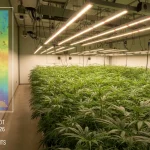
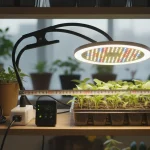
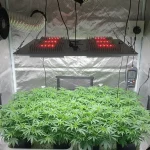
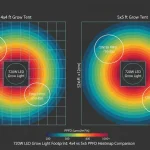
A vertical rack looks calm from the aisle—until you notice one shelf is thriving while the next has pale edges, stretched stems, or tip burn. In most vertical farms and multi-tier rooms, that “mystery variability” usually isn’t nutrients first; it’s light distribution and microclimate. This deep dive explains how a vertical LED grow light behaves in the real world—coverage, heat at the canopy, and what the ROI math actually depends on.
If you’re choosing lighting for vertical farming, under-shelf hydroponics, or tight grow rooms, the goal is simple: deliver uniform PPFD where plants sit, keep leaf temperature in the safe zone, and pay back the system fast.

What a “vertical LED grow light” really is (and where it fits)
A vertical LED grow light is typically a slim bar or linear fixture designed to mount along shelves, uprights, or under-canopy zones so photons reach plant surfaces evenly in constrained geometry. In vertical farming, it’s most often installed under each shelf (top-light replacement) or intra-canopy/side-lighting to push light into dense foliage.
Compared with large “panel” fixtures, vertical/linear bars make it easier to:
- Match the rectangle of a tray with multiple light sources (better uniformity)
- Reduce hot spots by spreading diodes across length
- Place light closer to the canopy without harsh peaks (when optics and spacing are right)
ABEST (ProLEDGrowLight.com) builds these systems at commercial scale—bars, boards, under-canopy, and clone lights—plus ODM spectrum and control so farms can tune recipes by crop and growth stage.
Coverage and PPFD uniformity: the make-or-break metric
Vertical farms don’t fail on average PPFD; they fail on non-uniform PPFD. One corner running 30% low can drag the whole tray’s harvest timing and grade.
How to evaluate coverage (without guessing)
I use a simple, repeatable workflow aligned with vertical-farm commissioning best practices:
- Fix the measurement plane (top of mature canopy, or a set height above the tray).
- Map a grid that matches your tray footprint; measure tighter near edges and corners.
- Stabilize conditions (normal dimming level, no stray light, consistent airflow).
- Record PPFD point-by-point and compute: Average, Min, Max, CV, and Uo (Min/Avg).
- Act on the pattern: edge deficit vs center hot spot requires different fixes.
For a practical primer on PAR/PPFD terms and how to interpret them, use this internal reference: LED Grow Light Review FAQ: PAR, PPFD, Heat, Cost.
Common uniformity problems in vertical racks (and fixes)
- Dim edges / corners (low Min PPFD)
- Add an extra bar near the perimeter or use wider beam optics
- Reduce bar-to-bar spacing or bring fixture slightly closer (carefully)
- Center hot stripe (high Max PPFD)
- Increase bar spacing, reduce overlap, or dim slightly
- Re-aim optics if the design allows
- Aisle-side asymmetry
- Use reflective side panels or mirrored layout on both aisle sides
- Confirm mounting is level (small tilts matter at short distances)
Mounting height in vertical systems: distance still matters, but PPFD matters more
A vertical LED grow light is usually closer to plants than top-hung room lights, so the “distance-to-canopy” rule-of-thumb is only a starting point. One widely cited guideline for LED distance by stage is:
- Seedlings: ~24–36 inches
- Vegetative: ~18–24 inches
- Flowering: ~12–18 inches
In vertical racks, shelves often can’t spare that distance—so you compensate with more linear sources at lower drive current, better diffusion/optics, and tighter uniformity targets instead of trying to blast intensity from one point.
When you’re dialing in a new rack, adjust in small steps and watch plant response (leaf curl, bleaching, stretch), not just inches.
Heat: why “LED runs cool” still causes crop problems in vertical farms
LEDs are more efficient than legacy HID, but they still turn a meaningful fraction of wattage into heat—just in a different way. In vertical racks, the issue is less “fixture scorching the canopy” and more microclimate layering: warm drivers/heat sinks near a shelf, restricted air movement, and leaf temperature drifting away from your ideal.
A real-world nuance I learned the hard way: I once fixed “light stress” symptoms by improving airflow, not by dimming. The PPFD was fine—but the leaf surface temp was running higher than the room sensor suggested, especially in the center of dense trays.
Canopy temperature vs room temperature
Growers often target an air temp that sounds right, but leaves can run warmer or cooler depending on IR load, transpiration, and airflow. Discussions in the grow community often point out that leaf surface temperature can differ several degrees from air temperature, so it’s worth measuring directly (IR thermometer) and tuning VPD and airflow accordingly.
For temperature targets by stage, see: Grow Room Temperature: Ideal Ranges by Plant Stage.
Practical heat-control checklist for vertical LED racks
- Ensure clear airflow paths across every tier (not just the aisle)
- Keep heat sinks/drivers from dumping heat into stagnant pockets
- Use lower watt density spread across more bars when shelf height is tight
- Clean lenses/bars routinely—dust reduces photons and increases waste heat behavior over time
Spectrum and controllability: why vertical farms benefit from multi-channel LEDs
Most vertical farming crops (leafy greens, herbs, clones) respond strongly to intensity and consistency, then to spectrum fine-tuning. Recent peer-reviewed work in controlled environments reinforces that higher PPFD commonly correlates with higher biomass, while spectral tweaks (deep red/far-red ratios, blue fraction) can adjust morphology and quality traits—useful, but not a substitute for uniform delivery.
In practice, the spectrum levers I see matter most in vertical racks are:
- More blue for compact growth and tighter node spacing (useful for seedlings and finishing)
- More red/deep red for efficient photosynthesis and faster biomass accumulation
- Careful far-red for canopy expansion and morphology shifts (timing and dose matter)
This is where ABEST’s ODM approach (custom spectra + multi-channel dimming, App/WiFi control) fits: you can run stage recipes without swapping fixtures, and you can standardize outcomes across many racks.
ROI: what actually drives payback for a vertical LED grow light
A vertical LED grow light ROI calculation is rarely just “watts saved.” The strongest payback stacks three buckets:
- Lighting electricity reduction (higher µmol/J, better optics, right PPFD target)
- HVAC savings (less waste heat than HID, less dehumidification knock-on)
- Revenue lift (better uniformity = fewer rejects, tighter harvest windows, sometimes higher yield)
Industry ROI frameworks emphasize accounting for both cost savings and yield-driven revenue—because increased PPFD (when paired with proper environment control) can translate into measurable output gains.
Modern top-tier fixtures can exceed 3.5 µmol/J, while many older installations were closer to ~2.0–2.5 µmol/J—implying potential 30–40% energy reduction for the same photon delivery when upgrading, depending on the baseline and design.

Quick ROI estimator (simple but useful)
- If you upgrade efficacy from 2.2 to 3.5 µmol/J, you can often cut lighting kWh for the same DLI by ~35–40%.
- If your rack is heat-limited, the real win is running target PPFD with less HVAC penalty.
For broader buyer-side due diligence, this internal checklist is helpful: LED Grow Light Depot: Buyer’s Checklist for 2026.
Vertical LED grow light vs HPS (and why vertical farms moved on)
HPS can still grow plants well, but it’s a poor physical match for multi-tier geometry because it concentrates heat and requires more distance from canopy. LED bars distribute light across the tray and typically reduce cooling demand—one reason LEDs became the default for vertical farms.
For an apples-to-apples perspective, see: Indoor LED Grow Light vs HPS: Which Wins Indoors?.
Spec sheet checklist: what to compare before you buy
Use this table when comparing vertical LED grow light options for racks, shelves, or under-canopy runs.
| Spec / Feature | What “Good” Looks Like | Why It Matters in Vertical Racks |
|---|---|---|
| Photon efficacy (µmol/J) | Higher is better (often 2.7–3.5+ commercial) | Directly reduces kWh per DLI and lowers heat per photon |
| PPFD uniformity target | High uniformity; track Min/Avg (Uo) and CV | Predictable growth, fewer edge runts, consistent harvest timing |
| Form factor | Linear bars sized to tray geometry | Better coverage mapping and easier tier integration |
| Optics / diffusion | Designed for close mounting without hot spots | Prevents striping and localized stress |
| Dimming control | Smooth, stable dimming; multi-channel if possible | Lets you hit DLI targets and run stage-based recipes |
| Thermal design | Quality heat sinking + driver placement | Reduces hot pockets and improves lifespan |
| IP rating / corrosion resistance | Appropriate for humidity and cleaning routines | Prevents premature failures in wet CEA environments |
| Warranty + support | Clear terms, real engineering support | Critical when you scale to many racks |
Commissioning tips: how to make a vertical LED grow light succeed on day one
When I commission a new rack lighting layout, I prioritize repeatable measurements and small adjustments:
- PPFD map first, before changing nutrients or CO₂.
- Aim for uniformity, then raise intensity—uniform photons beat “high average” every time.
- Confirm photoperiod + DLI match the crop plan (don’t chase PPFD alone).
- Validate leaf temperature and airflow per tier; fix dead zones.
- Lock the recipe, then document mounting height, bar spacing, dimming %, and maintenance intervals.
LED grow light for Vertical farming

Conclusion: the “quiet win” of vertical lighting is consistency
A vertical rack is like a team: one weak corner slows everyone down. The right vertical LED grow light setup wins by making every tray position predictable—uniform PPFD, manageable canopy temperature, and a control system that matches your crop stages. When you stack those basics, ROI becomes less about marketing claims and more about fewer rejects, tighter scheduling, and lower kWh per kilogram.
If you’re planning a new rack build or retrofitting older tiers, share your tray size, crop, target DLI, and shelf height in the comments—those four details determine 80% of the lighting design choices.
📌 grow smarter not harder the led grow light bar that actually works
FAQ: Vertical LED Grow Light
1) How many vertical LED grow light bars do I need per shelf?
It depends on tray width, mounting height, and your PPFD target. In tight shelves, more bars at lower power usually beats fewer bars at high power because it improves uniformity.
2) What PPFD is best for leafy greens in vertical farming?
Many farms run roughly 150–250 µmol/m²/s depending on crop, cultivar, and desired DLI. Use DLI and growth goals to set PPFD, then validate with mapping.
3) Why do my tray edges grow slower under vertical LED bars?
Edge losses are usually a uniformity/layout issue: bar spacing, optics, mounting height, or reflective surfaces. A PPFD grid map will show the deficit pattern clearly.
4) Do vertical LED grow lights reduce HVAC costs?
Often yes—higher efficacy means fewer watts for the same photons, which reduces heat load. In vertical racks, airflow design still matters because microclimates can persist even with efficient LEDs.
5) Can I mount LEDs very close to the canopy in a vertical rack?
Yes, if the fixture is designed for close mounting (diffusion/optics) and you maintain uniformity. Measure PPFD and watch leaf temperature and stress symptoms.
6) Is spectrum tuning worth it, or should I focus on intensity?
Start with intensity and uniformity because they drive most biomass outcomes. Spectrum tuning is the second step to refine morphology, color, and quality once basics are stable.
7) How do I calculate ROI for a vertical LED grow light upgrade?
Compare kWh for the same DLI (using µmol/J), add HVAC changes, and include revenue effects from better uniformity or higher throughput. Also factor maintenance and fixture lifespan.
Authoritative references: PPFD uniformity measurement & fixes, LED distance guidelines by growth stage, LED ROI framework.