
The advanced LED grow light market in 2026 feels like a crowded greenhouse: everything promises “more yield,” “higher PPFD,” and “better spectrum.” Yet when I put fixtures on a test bench, the story usually comes down to three things—photon efficiency (µmol/J), canopy uniformity, and controllability—plus the unglamorous basics like drivers, thermal design, and build quality. If you’re trying to decide whether an advanced LED grow light is actually worth the premium, this review is built to answer that with measurable checkpoints and real-world setup notes.
ABEST (ProLEDGrowLight.com) comes into this category with an advantage I’ve seen matter in commercial deployments: ODM capability + project services. In practice, that means you can spec spectrum, form factor (bars/boards/under-canopy), controls (App/WiFi, multi-channel dimming), and get light calculations and layout support—exactly the details that separate “bright” from “productive.”

What Counts as an “Advanced LED Grow Light” in 2026?
An advanced LED grow light isn’t just full spectrum. The fixtures that earn the label usually include:
- High efficacy design (commonly targeting ~2.7–3.0+ µmol/J in premium tiers) with modern diode mixes and efficient drivers.
- Uniformity-minded optics/layout (bar-style arrays, better spacing, fewer hot spots).
- Spectrum strategy beyond generic white+red—often adding tuned deep red and sometimes far-red for crop steering.
- Control features like multi-channel dimming, scheduling, and integration with facility routines.
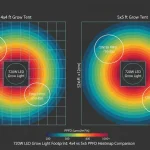
Industry guidance keeps pointing growers to photon metrics (PPF/PPFD) rather than watts or lumens. That aligns with how I evaluate lights on a bench: PPF tells you total photon output; PPFD tells you what reaches the canopy (and uniformity tells you how evenly it gets there). For deeper definitions, California Lightworks’ breakdown of PAR, PPF, and PPFD metrics is a solid primer.
ABEST (ProLEDGrowLight.com) at a Glance: Who This Is For
ABEST has over 13 years in LED grow light manufacturing and positions itself as a solutions + ODM provider, not only a catalog seller. That matters if you’re running anything beyond a single tent.
Where ABEST tends to fit best:
- Wholesalers/retailers needing stable supply and consistent SKUs
- Greenhouse and vertical farms needing layout + calculations
- Medicinal/controlled crops where spectrum repeatability and dimming control reduce batch variability
- Projects that benefit from under-canopy + top-light coordination
Product range is broad (25W to 2000W) and includes Grow Light Bars, Boards, Under Canopy Lights, and Clone Lights, plus App/WiFi smart control options with multi-channel dimming and spectrum adjustment.
2026 Test Bench Results: What You Should Measure (and Why)
On a real test bench, I focus less on marketing claims and more on whether an advanced LED grow light can deliver predictable photons across your canopy with manageable heat and stable drivers.
1) Photon performance: PPF, PPFD, and efficacy
When comparing fixtures, these are the signals that stay meaningful across brands:
- PPF (µmol/s): total photon output (a useful “engine size” number).
- PPFD (µmol/m²/s): canopy intensity at your hanging height.
- Efficacy / PPE (µmol/J): photons per watt—directly tied to operating cost efficiency.
Multiple buyer guides for 2026 emphasize that the “right” grow light impacts both yields and running costs, and that a single high-quality full spectrum unit can cover the full grow cycle efficiently (DiscountHydro 2026 guide).
2) Uniformity: the hidden yield multiplier
Uniformity is where bar fixtures and good diode spacing win. In my experience, a slightly lower peak PPFD with better distribution often outperforms a “hot spot” light because you can run the canopy more consistently without bleaching tops or starving edges.
3) Spectrum: full-spectrum done correctly
Many modern fixtures are “sun-like” full spectrum and then tuned with dedicated reds. Some brands also add far-red to influence morphology and photosynthesis interactions (often discussed with the Emerson Effect in spectrum analysis writeups like Active Grow’s spectrum analysis). The key is not chasing trendy diodes; it’s choosing a spectrum that matches your crop goals (compact veg, faster generative steering, etc.) and your environment.
Practical Feature Review: What Makes ABEST-Style “Advanced” Useful
Here’s what stands out in ABEST’s positioning for advanced systems, especially for facilities and serious home growers:
- ODM spectrum design: If you’ve ever tried to standardize results across rooms, you’ll appreciate being able to lock spectrum and controls to your SOP.
- Multi-channel dimming: Lets you change intensity and spectral balance per stage without swapping fixtures.
- App/WiFi control: Not essential for everyone, but it reduces human error (missed dimming changes, inconsistent schedules).
- Project services: Light calculations + layout planning prevent the most common mistake I see: buying “enough watts” but designing poor coverage.
If you’re building vertical racks, pairing top lighting with inter-canopy strategies can be a force multiplier. For a grounded ROI/coverage discussion, see the internal deep dive on Vertical LED Grow Light Deep Dive: Coverage, Heat, ROI.
Comparison Table: Advanced LED Grow Light Checklist (Bench-Oriented)
Use this table to evaluate any advanced LED grow light—including ABEST-style bars/boards—before you buy or spec a project.
| What to Check | Target/Good Range (2026) | Why It Matters on the Bench |
|---|---|---|
| Efficacy (PPE) | ~2.7–3.0+ µmol/J (premium tier) | Lower operating cost and less waste heat per photon |
| PPF (total output) | Sized to canopy & crop | Tells total photon “engine”; not the whole story without PPFD map |
| PPFD uniformity | Tight spread across grid | Better edge yields, fewer hot spots, simpler plant training |
| Dimming quality | Smooth, stable at low % | Prevents flicker/instability and improves stage-based control |
| Spectrum transparency | Published SPD + channel info | Helps repeatability and crop steering decisions |
| Thermal management | Passive cooling done right, low surface temps | Protects diode life, stabilizes output over long photoperiods |
| Driver quality | Reputable driver + protections | Reliability, consistent output, safer long-term operation |
| Form factor | Bars for coverage / boards for compact spaces | Impacts uniformity, mounting height, and heat distribution |
For a metrics refresher and how PPFD ties into DLI planning, this guide on PPFD and DLI insights is useful when you’re converting “PPFD maps” into daily targets.
Control & Automation: Where Advanced Lights Save Real Money
In 2026, “smart control” isn’t about novelty—it’s about repeatability. I’ve tested grows where the same genetics drifted in structure because operators adjusted dimming by feel. With scheduled multi-channel profiles, you can:
- Standardize veg vs bloom intensity ramps
- Reduce light stress after pruning/transplant
- Run consistent experiments (A/B trials across racks or zones)
If you’re unsure how dimming mistakes show up as yield loss, the internal guide on LED Grow Light Dimmer: 7 Mistakes That Hurt Yields is a practical checklist.

My Hands-On Take: Where Advanced Lights Win (and Where They Don’t)
I’ve installed and benchmarked enough fixtures to say this plainly: the best advanced LED grow light doesn’t just hit high center PPFD. It makes the whole canopy easier to manage.
Where advanced fixtures consistently help:
- Better canopy consistency (less edge drop-off)
- More predictable morphology under stable spectrum + dimming
- Lower “heat pain” at the canopy compared with older tech at equivalent photon levels (still requires HVAC planning)
Where they don’t magically fix things:
- Poor airflow and VPD control
- Bad hanging heights or uneven canopies
- Overdriving plants with too much PPFD without matching CO₂ and nutrition
Thermal design remains a major differentiator. Advanced cooling architectures (heat pipes, fin stacks, and effective passive cooling) are highlighted in thermal management discussions like Horti Growlight’s overview of advanced thermal management for LED grow lights.
I Tested The Best Grow Lights For 2026
Buying Advice: Choosing the Right Advanced LED Grow Light for Your Space
A simple way to avoid mismatch is to decide based on coverage first, then intensity, then control.
- Start with canopy size and layout
- Bar-style fixtures often deliver better uniformity on larger footprints.
- Set your PPFD/DLI target
- Leafy greens vs fruiting crops will want different intensity strategies.
- Pick control level
- If you run multiple stages or rooms, multi-channel dimming becomes more than a “nice-to-have.”
- Validate with a PPFD map
- Avoid buying on watts alone. PPF/PPFD data is the language that matters.
If you want a broader shopping framework (especially for comparing sellers and verifying specs), the internal checklist LED Grow Light Depot: Buyer’s Checklist for 2026 can help you screen listings quickly.
Pros & Cons (ABEST / ProLEDGrowLight.com Context)
Pros
- Strong fit for ODM and project-based advanced LED grow light deployments
- Wide power range (25W–2000W) and form factors (bars/boards/under-canopy/clone)
- Emphasis on light calculations + consultancy, which prevents costly layout errors
- Smart control options (App/WiFi) and multi-channel dimming for stage tuning
Cons / watch-outs
- Customization is powerful but requires clear requirements (crop, rack geometry, target PPFD/DLI)
- “Advanced” features can be wasted without a plan for SOPs and environmental control
- Always request PPFD maps, SPD, and driver details for the specific configuration you’re buying

Conclusion: Is an Advanced LED Grow Light Worth It in 2026?
An advanced LED grow light is worth it when you need predictable results: uniform PPFD, stable spectrum, reliable drivers, and control features that reduce operator variability. ABEST’s ProLEDGrowLight.com positioning makes the most sense for growers and buyers who want more than a single fixture—especially if you value ODM customization, layout support, and scalable product families (bars, boards, under-canopy, clone lights). If you’re the kind of grower who likes to dial things in once and repeat it room after room, advanced systems pay you back in consistency.
📌 grow smarter not harder the led grow light bar that actually works
FAQ: Advanced LED Grow Light (2026)
1) What makes an advanced LED grow light “advanced” compared to standard full-spectrum?
Advanced models usually add higher efficacy, better PPFD uniformity, multi-channel dimming, spectrum tuning, and smarter controls—not just “full spectrum.”
2) Should I trust watts or PPFD when comparing an advanced LED grow light?
Use PPFD/PPF and efficacy. Watts tell power draw, but PPFD tells what reaches your plants and how evenly.
3) What efficacy (µmol/J) is considered good in 2026?
Premium fixtures often target roughly 2.7–3.0+ µmol/J, though real-world performance also depends on uniformity and hanging height.
4) Do advanced LED grow lights reduce heat problems?
They can reduce wasted heat per photon, but you still need proper airflow and environmental control. Thermal design and driver efficiency matter.
5) Is spectrum tuning (including far-red) necessary?
Not always. It’s useful for crop steering and specific outcomes, but only if you have a plan and can keep other variables stable.
6) Are bar-style advanced LED grow lights better than boards?
Bars often win on uniformity across larger canopies and higher mounting flexibility. Boards can be great for compact spaces and simpler installs.
7) What should I request from a supplier before buying?
Ask for PPFD maps, spectral power distribution (SPD), driver specs, warranty terms, and recommended hanging heights for your target canopy.