
A LED grow light Viparspectra setup usually starts the same way: you’ve got a tent (or a shelf), plants that are leaning toward the window, and one question—which light is “enough” without wasting money or cooking your canopy? I’ve helped spec and troubleshoot a lot of budget-to-midrange LED rooms, and Viparspectra comes up often because it’s accessible, widely reviewed, and simple to run. This guide breaks down real-world pros/cons, which models fit which footprint, and how to hang/dim for healthier growth.

Why Viparspectra is popular (and what to expect)
Viparspectra has built a reputation around value-focused full-spectrum LEDs with features people actually use: onboard dimming, decent diode choices on newer lines, and “plug-and-grow” installation. In independent grows and reviews, the recurring theme is that the lights can produce solid results when matched to the right area and not pushed too close to the canopy. For example, Pepper Geek’s review of the XS1500 Pro emphasizes uniformity improvements and practical dimming/daisy-chain convenience for small spaces, especially around a 2×2 footprint.
At the same time, “budget-friendly” often means a few tradeoffs: less advanced control (vs. commercial fixtures), occasional quirks in dimming increments, and support experiences that vary by region and seller. If you want the best outcome with a LED grow light Viparspectra, the biggest lever isn’t brand—it’s correct PPFD/DLI for your plant stage and an honest match between wattage and coverage.
Pros and cons of a LED grow light Viparspectra (practical, not hype)
The biggest pros
- Strong value per dollar for hobby grows and small tents, especially in the XS/Pro/KS lines.
- Beginner-friendly controls (dimmer knob; many models support daisy-chain dimming).
- Improved distribution on newer “lens” or bar-style designs, which helps reduce hot spots and edge fade.
- Good results documented in grows when hung high enough and dialed in (e.g., comparisons and journals hosted by GrowWeedEasy show competitive performance vs. smaller HPS in certain setups).
The most common cons
- Coverage claims can be optimistic, especially for flowering. A light that “fits” a 3×3 veg may not flower that full area at ideal intensity.
- Dimming can be stepped on some models (set percentages rather than smooth 1% adjustments), which makes fine-tuning harder.
- Support/reliability perception varies depending on where you buy and local warranty handling; always verify the seller and return window. (Checking brand FAQs and third-party service review sites before purchase is smart.)
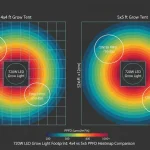
To get the most from any LED grow light Viparspectra, plan around measured PPFD maps and your crop target—not the biggest coverage number on a listing.
Best Viparspectra models by grow space (quick picks)
These recommendations focus on fit-to-footprint and typical use cases.
1) 2×2 tent: XS1500 Pro / XS series equivalents
If your priority is uniformity in a small square, the XS1500 Pro-class light is a common sweet spot. Pepper Geek specifically calls out the XS1500 Pro’s distribution improvements and suitability for a 2×2 area, with daisy-chaining useful if you expand later.
Good for:
- Seedlings → veg → flower in one small tent
- Peppers, herbs, leafy greens, compact flowering plants
Watch-outs:
- Don’t treat it like a 3×3 flower light; you’ll end up underlit at the edges.
2) 3×3 tent: step up in wattage or move to bar-style (KS/XS3000 class)
For 3×3 flowering, you generally want more total output and better spread. Viparspectra’s bar-style offerings (like KS series) are designed to improve canopy uniformity.
Good for:
- Full 3×3 veg
- More confident 3×3 flowering (depending on target PPFD)
Watch-outs:
- Heat management still matters; keep driver placement and exhaust in mind.
3) 4×4 tent: KS5000-class bar lights (or multiple smaller fixtures)
The KS5000 is widely discussed as a 500W-class bar fixture using higher-end diodes (Samsung LM301H + Osram reds are commonly cited in reviews and videos). Bar geometry tends to win in 4×4 for evenness.
Good for:
- 4×4 veg and flower with more even distribution than single-board “hot spot” styles
- Growers who want fewer shaded corners
Watch-outs:
- Verify your electrical plan and ventilation; 500W+ still becomes room heat.
ViparSpectra KS5000 PAR & ePAR Tests and Review by Dr MJ Coco
Comparison table: Viparspectra series and what they’re best at
Use this table to pick the type of Viparspectra light before you pick the exact model.
| Viparspectra line (common) | Typical form factor | Best for | Strengths | Limitations to plan for |
|---|---|---|---|---|
| XS Series / XS Pro | Board with improved optics/lens (model-dependent) | 2×2 to 3×3 (varies by wattage) | Strong value, good small-tent fit, often dimmable + daisy-chain | Some models have stepped dimming; flowering coverage can be smaller than “max” claim |
| Pro Series (P1000/P2000/P4000) | Board-style | Budget grows, simple setups | Easy setup, efficient enough for the price | Less “commercial” control; verify PPFD map for edges |
| KS Series | Bar-style fixture | 3×3 to 4×4 | Better spread/uniformity, strong components on newer models | More upfront cost; needs solid ventilation planning |
| Older blurple/reflector styles | Panel with mixed colors | Strict budget, legacy setups | Cheap entry point | Less efficient and less pleasant to work under; often inferior uniformity |
How high to hang and how hard to dim (real-world starting points)
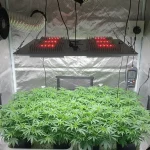
Most disappointment with a LED grow light Viparspectra comes from running it too close at 100% early on. In a GrowWeedEasy journal, the grower noted plant stress/deficiency-like symptoms when the light was too close and saw improvement after moving it to about 24″ away, then adjusting gradually. Pepper Geek also shares a practical baseline for small-plant growth: around 15″ above foliage at ~50–75% power for long photoperiods (context: peppers/seedlings), then ramping as plants harden.
Use these as starting ranges, then adjust based on plant response and measured PPFD if you have a meter:
- Seedlings/clones: higher hang + lower power (avoid bleaching and stalled roots)
- Veg: lower gradually or increase dimmer in small steps every 2–3 days
- Flower/fruiting: aim for even canopy coverage first, intensity second
If you want a better technical handle on PPFD/PAR tradeoffs, this internal guide explains it clearly: LED Grow Light Review FAQ: PAR, PPFD, Heat, Cost.
Coverage and PPFD: the “truth” behind the marketing numbers
Here’s the rule I use when auditing grows: flower coverage is the honest coverage. Veg can tolerate lower PPFD; flowering/fruiting quality usually can’t. Viparspectra’s own product pages sometimes specify separate veg vs flower footprints (for example, XS3000 Pro listings commonly break out veg coverage larger than flower coverage), which is exactly how you should think about it.

Practical tip: if your corners lag, you’ll often do better with:
- A bar-style fixture (more even distribution), or
- Two smaller fixtures spaced apart vs one concentrated panel
For a deeper read on how layout affects uniformity in stacked racks and tight footprints, see: Vertical LED Grow Light Deep Dive: Coverage, Heat, ROI.
Reliability, warranty, and support: what I check before buying
With any consumer LED, I recommend three checks before you commit:
- Buy from a seller with a clean return window (especially if you can’t test PPFD immediately).
- Confirm warranty terms on the official FAQ page and match them to your region. Viparspectra publishes general support info here: ViparSpectra FAQ.
- Sanity-check service reputation on a third-party platform for recent patterns (not just star rating). For example: Viparspectra reviews on Trustpilot.
This isn’t about fear—just avoiding headaches. I’ve seen “bad light” reports that were actually shipping damage, wrong driver settings, poor ventilation, or a seller who wouldn’t process a return.
When Viparspectra is the right pick—and when to consider ODM/custom solutions
A LED grow light Viparspectra is often the right choice if you want a ready-to-run fixture for a small to mid-size personal grow, and you’re okay with standard spectrum/control options. But if you’re running multi-tier racks, crop-specific spectrum targets, or need consistent binning and documentation across batches, going ODM can be a smarter long-term play.
At ABEST (ProLEDGrowLight.com), we’ve built ODM programs for growers who need:
- Custom spectrum design (crop-specific reds/blues/far-red balance, multi-channel tuning)
- Form factor choices (bars, boards, under-canopy, clones)
- Project services like light calculations, layout planning, and control system adaptation
If you’re scaling beyond a single tent, it’s worth comparing off-the-shelf fixtures vs a designed solution. This internal resource also helps you avoid common buying traps: LED Grow Light Depot: Buyer’s Checklist for 2026.

Quick decision checklist (buy smarter in 60 seconds)
Use this checklist before you choose a model:
- What’s your true flowering footprint? (2×2, 3×3, 4×4)
- Do you need uniformity or intensity most? (uniformity usually wins)
- Will you expand later? If yes, prioritize daisy-chain dimming and modular layouts.
- Can you manage heat? Bigger wattage is still “room heat,” even with LEDs.
- Do you have a PPFD meter? If not, plan conservative hang heights and ramp slowly.
Conclusion: the “best” Viparspectra is the one matched to your canopy
A LED grow light Viparspectra can be a solid, budget-smart engine for indoor growing—if you size it honestly, hang it thoughtfully, and tune intensity by stage. I’ve seen these lights perform impressively in small tents when growers stop chasing maximum coverage claims and start chasing even PPFD across the canopy.
📌 grow smarter not harder the led grow light bar that actually works
FAQ: Viparspectra LED grow light questions people search
1) Which Viparspectra LED grow light is best for a 2×2 tent?
Look for an XS1500-class fixture (often the XS1500 Pro) sized for 2×2 flowering, focusing on uniformity and dimming control.
2) How high should I hang a Viparspectra LED grow light?
Start higher than you think and lower gradually. Many growers begin around 18–24″ and adjust based on plant response; some small-crop setups run closer with reduced dimming.
3) Is Viparspectra good for flowering, or only veg?
It can be good for flowering if you match the model to the flower footprint and maintain adequate PPFD across the canopy (not just in the center).
4) What’s the difference between Viparspectra XS, XS Pro, Pro Series, and KS Series?
Generally: XS/Pro are board-style (some with lens improvements), while KS is bar-style for better spread. Features and diode/driver choices vary by generation.
5) Does Viparspectra run hot?
LEDs are more efficient than HPS, but the wattage still becomes heat in your space. Ventilation and driver placement matter.
6) Should I buy one big Viparspectra or two smaller ones?
For wider canopies, two smaller fixtures often improve edge coverage and uniformity compared to one concentrated panel.
7) How do I know if my Viparspectra light is too strong?
Watch for bleaching, tacoing leaves, stalled growth, or “deficiency-looking” symptoms that improve when you raise the light or dim it—then confirm with PPFD measurements if possible.